Only 11% of companies are operating generative artificial intelligence (AI) at scale, according to McKinsey research on enterprise AI adoption. The other 89% are running pilots, planning deployments, or stuck between the two. The bottleneck is almost never the AI model itself. It is the infrastructure required to connect that model to the way your organization actually operates.
This is the problem ARUO was built to solve. And it is not a technology problem. It is an architecture problem.
The demo always works. Production is where it breaks.
Most AI demos follow the same script: a prompt goes in, an impressive response comes out. Nobody challenges whether the model knows your product catalog or can access your internal documents.
In production, those questions surface immediately. The answers require infrastructure, not better prompts.
A large language model (LLM) is trained on vast amounts of publicly available text. It knows a great deal about the world in general. It knows nothing about your specific business: your internal policies, your client data, your operational rules. Think of it as a highly capable new hire who has read everything on the internet but has never set foot in your office, and has no idea how your organization actually runs.
Bridging that gap is where most enterprise AI projects either succeed or stall.
The three layers most organizations underestimate
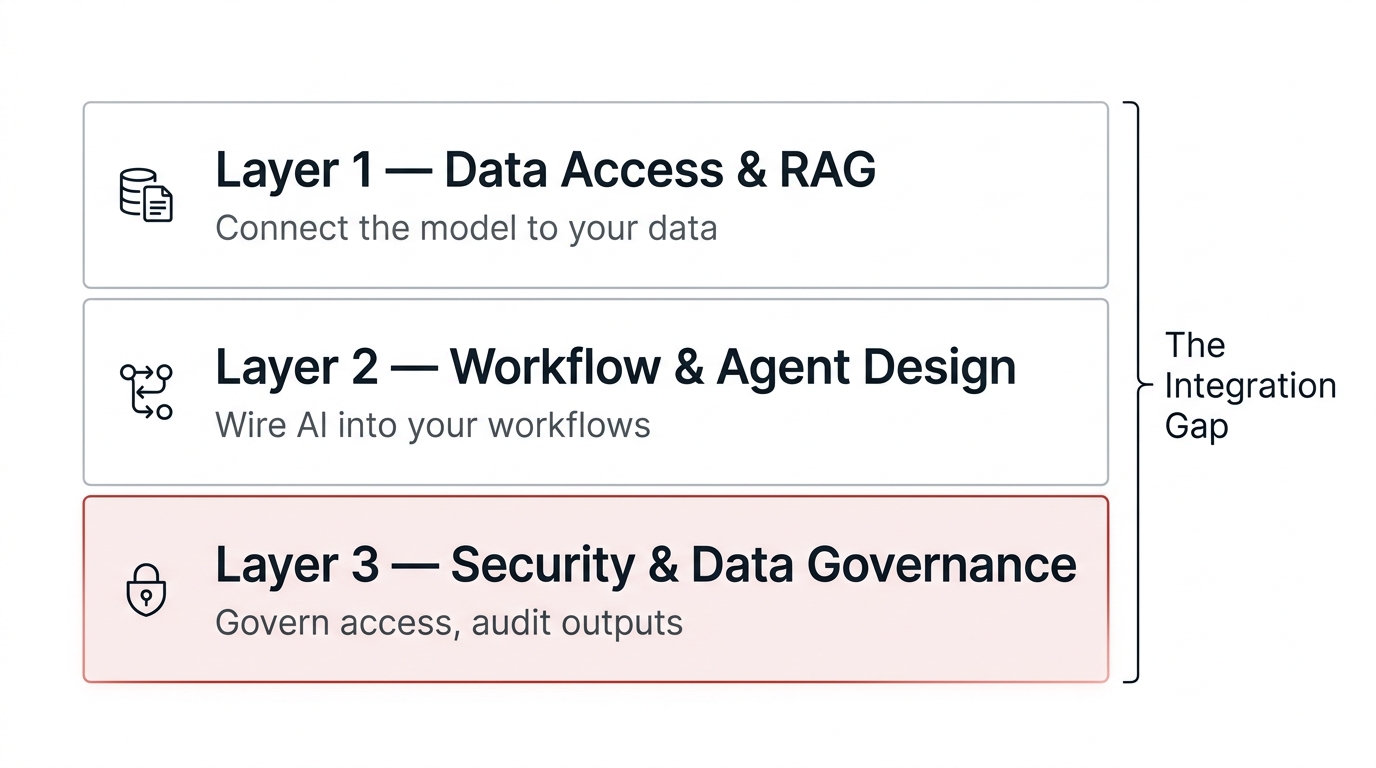
At ARUO, we have seen the same pattern repeat across industries. Organizations focus on the model selection and the user interface. They defer three layers of work that turn out to be the majority of the actual build.
Layer 1: Data access and retrieval
An LLM that cannot see your internal data will either generate a generic answer or a specific-sounding wrong one. In AI terminology, that second failure mode is called hallucination: confident output that is not grounded in verifiable facts.
The structural fix is retrieval-augmented generation (RAG), an architecture that connects the model to your internal knowledge sources at the moment of each query. Instead of relying solely on training data, the model retrieves relevant documents from your own systems first, then generates a response grounded in what it found.
The key point: no amount of prompt refinement solves a data access problem. If the model cannot see your inventory database, your client history, or your internal procedures, a better-worded question will not fix the output. The retrieval layer has to be built. In nearly every engagement we begin, this layer is either missing from the plan or significantly underspecified.
Layer 2: Workflow integration and agent design
A chat interface is a tool. Most business processes are workflows: an incoming request triggers a classification, which triggers a lookup, which triggers a draft response, which routes to a review step before anything reaches a customer.
Agent architecture is what turns an LLM from a chat tool into a participant in that workflow. An agent can read an incoming message, decide which action to take next, query an internal system, draft a response, and route it to a human reviewer before it goes anywhere. That chain of steps requires deliberate design, testing, and integration with your existing systems.
Organizations consistently underestimate this build time. In our experience, teams spend the first two weeks on the model and the next three months on the integration. The model is not the work. Wiring it into your processes, with appropriate error handling and fallback paths, is.
Layer 3: Security and data governance
Using an AI model on customer data, employee records, or proprietary research introduces a category of risk that most pilots defer rather than address. Which data does the model access? Who is accountable when it produces an error in a client-facing context?
These are not optional questions. They are the questions your legal, compliance, and information security teams will raise before any production deployment is approved. We see this pattern regularly: organizations treat security architecture as a post-launch step and then find themselves rebuilding large portions of the system when the security review comes back with blockers.
Designing for security from the start is not slower. It is faster, because it avoids that rework cycle.
From human-in-the-loop to human-on-the-loop
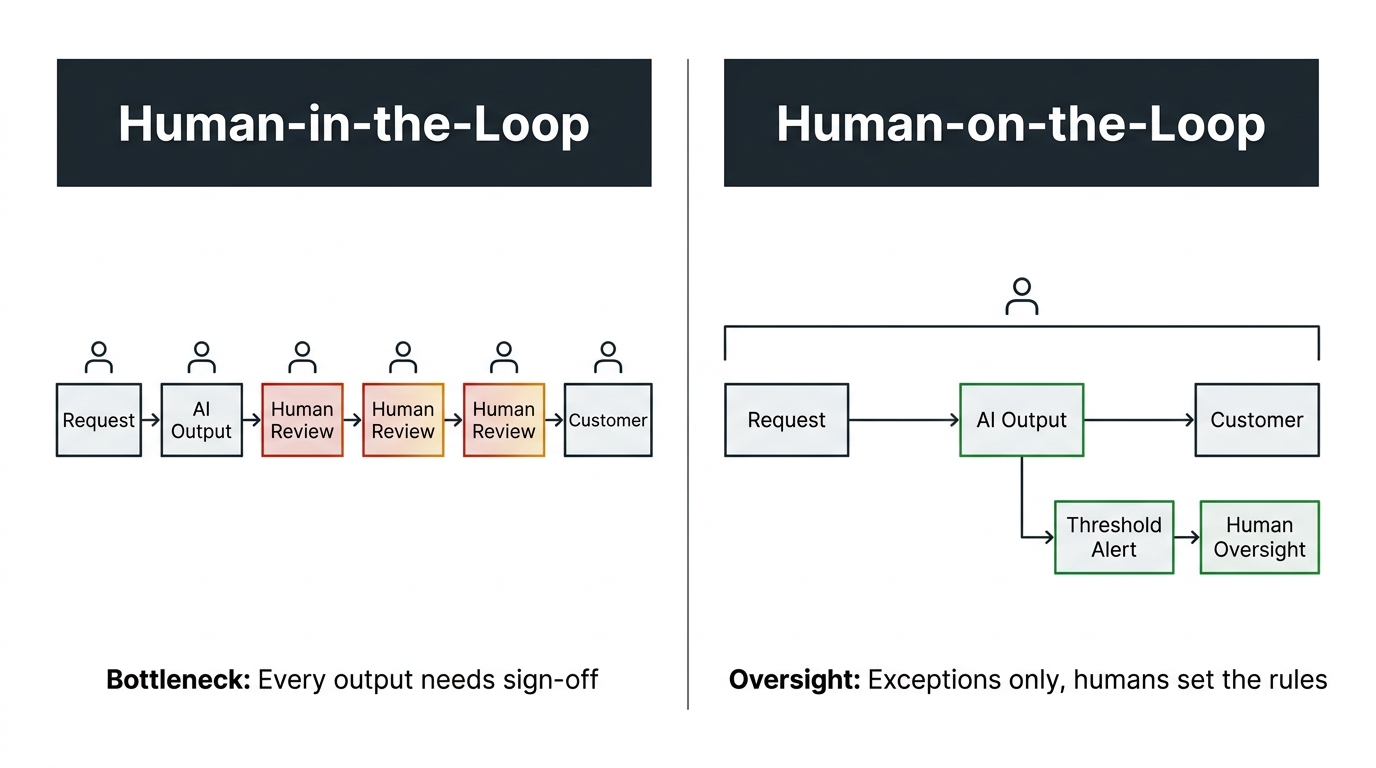
Early AI deployments used a human-in-the-loop (HITL) model: a human reviews every AI output before anything moves forward. This is safe, but it creates a bottleneck. If every response requires manual sign-off, the speed advantage of AI largely disappears.
More mature deployments operate on a human-on-the-loop (HOTL) model. In this setup, the AI handles routine work autonomously. A human monitors the outputs, sets escalation thresholds, and intervenes when something falls outside acceptable parameters. The human is no longer inside every transaction. They are overseeing the system that processes them.
This shift requires more upfront design than most organizations plan for. You need to define what "normal" looks like for each workflow, what constitutes an escalation trigger, and what the fallback process is when the model encounters something it cannot handle reliably. Organizations that skip this design work end up with a system their teams do not trust.
What the actual build looks like
The phrase "AI integration" tends to suggest application programming interface (API) keys and software installs. In practice, the work looks more like this:
- Auditing which internal data sources the model needs to access, and how those sources are structured for retrieval
- Designing the RAG pipelines that surface the right documents at the right moment without exposing data the model should not see
- Mapping existing workflows to identify which steps can run autonomously and which require human review as a non-negotiable checkpoint
- Building the security architecture that governs what data the model accesses and how every output is logged and attributed
- Running structured tests against edge cases before any component touches production data
This is systems integration work. It requires people who understand both how language models behave and how enterprise environments are governed. A model provider gives you the capability. This work builds the system around it.
Where most organizations are in this process
In our conversations with enterprise teams, we see three common positions:
- Still in demo mode, trying to figure out the right use case.
- Committed to a use case but hitting the data access and security blockers.
- In production on a narrow workflow, looking to expand without rebuilding from scratch.
Each position requires a different next step. What they share is that the constraint is rarely the model.
At ARUO, we assess where an organization is in this process and design the architecture that moves it forward: the retrieval layer, the agent workflows, the security setup, and the human oversight model. The goal is not a successful demo. It is a system your team uses in production.
Contact ARUO at hello@aruo.tech to talk through where your organization is and what the right next step looks like.