The infrastructure tax hiding in your AI budget
Companies that moved fast to deploy large language models (LLMs) in 2024 and 2025 face a version of the same problem: the bill keeps growing, but the business outcomes do not scale with it.
A sales team at a mid-sized Japanese manufacturer uses an AI assistant to draft customer emails, check inventory levels, and summarize meeting notes. Every single one of those requests, whether it is a one-line status check or a complex multi-step analysis, gets routed to the same premium frontier model. The cost structure mirrors a company that sends all couriers, from a birthday card to a pallet of industrial equipment, by overnight express.
This is not a fringe case. A market forecast published by Astute Analytica on August 13, 2026 valued the global AI model router market at roughly $100 million in 2025 and projected it to reach $4.1 billion by 2035, a compound annual growth rate (CAGR) of 44.9%. Markets do not grow at that rate without real pain driving demand.
The pain is computational waste: the systematic allocation of expensive, high-capacity reasoning to tasks that require neither.
What model routers actually do
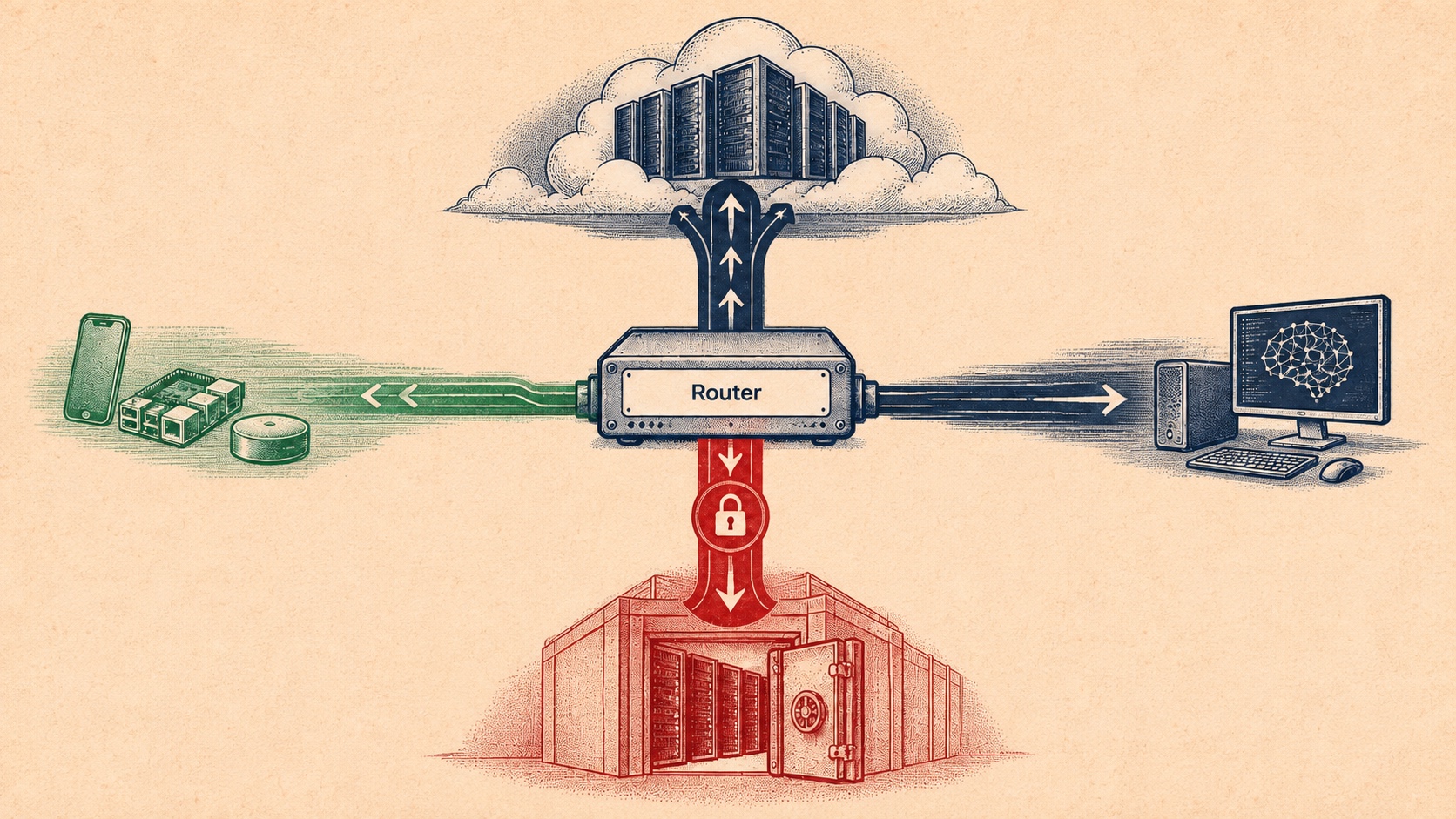
An AI model router is a middleware layer that sits between an application and the pool of available AI models. For every incoming prompt, the router evaluates a set of criteria, typically in milliseconds, and dispatches the request to the model best suited for that specific task.
Astute Analytica identifies four primary routing criteria:
- Cost optimization: Route low-complexity tasks to cheaper, lighter models.
- Quality and accuracy: Reserve high-capability models for tasks that require precise reasoning.
- Latency: Prioritize edge or local models when response speed is critical.
- Policy and compliance: Block sensitive prompts from leaving the corporate perimeter by routing them to on-premises models.
The fourth criterion is often where enterprise adoption accelerates. A legal team's contract summary involves confidential counterparty terms. A finance team's forecast involves non-public projections. Routing those prompts to a public cloud API carries regulatory and reputational risk that most compliance officers will not accept. A model router enforces that boundary automatically, without requiring the end user to think about it.
The cost reduction case is already documented
In July 2024, researchers at LMSYS (a research organization behind the Chatbot Arena benchmarking platform) published a framework called RouteLLM that offered early quantitative evidence of what intelligent routing can achieve.
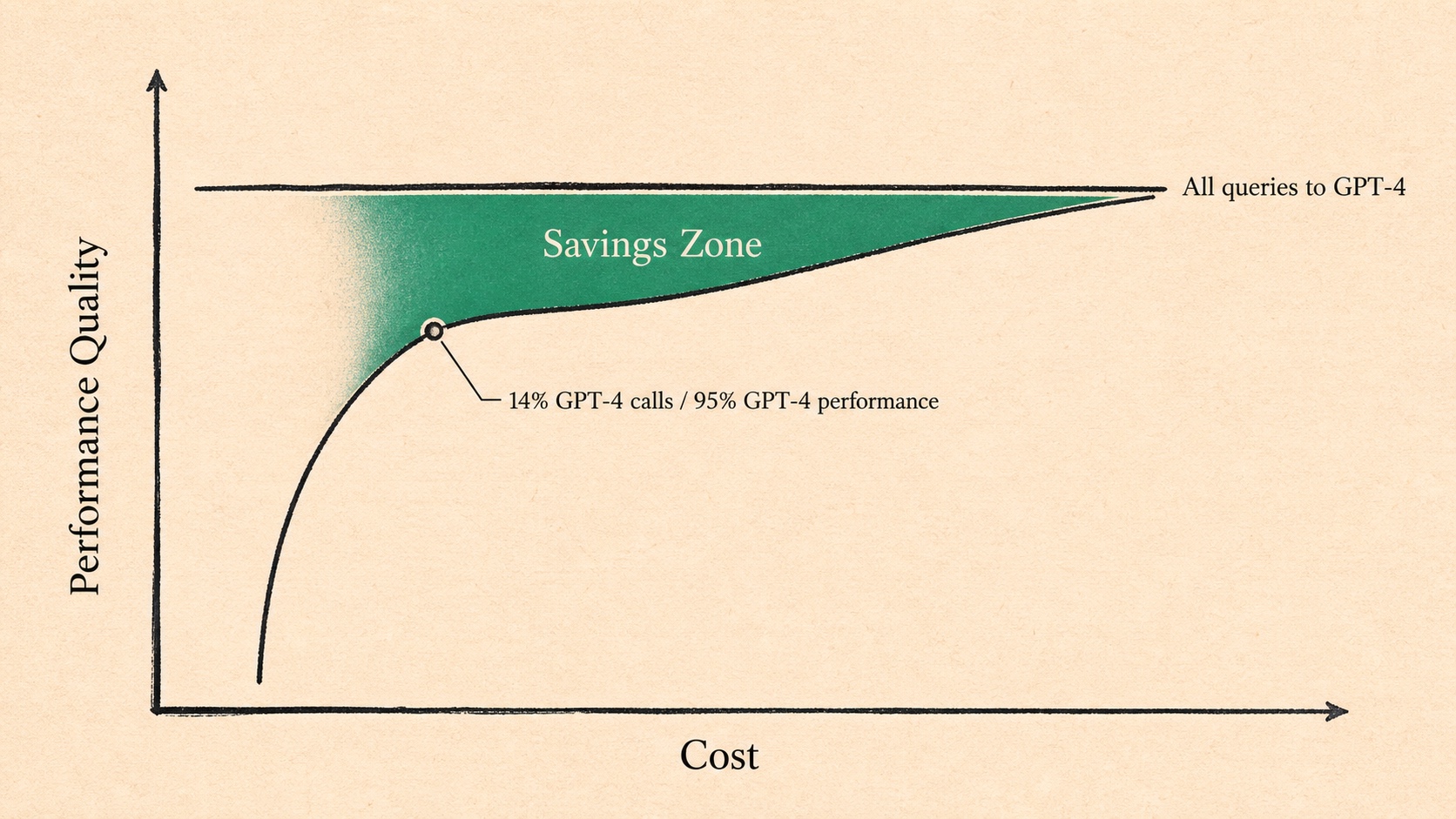
Routing between GPT-4 Turbo and Mixtral 8x7B, the LMSYS RouteLLM research reported that their best-performing matrix factorization router could achieve 95% of GPT-4's benchmark performance while directing only 14% of queries to GPT-4, which they measured as 75% cheaper than a random routing baseline. Across MT Bench as a whole, their routers demonstrated cost reductions of over 85% compared to routing all queries to GPT-4. The same routers generalized to different model pairs, including Claude 3 Opus and Llama 3 8B, without retraining. That transferability matters for enterprises that operate across multiple vendor contracts.
Eighty-five percent is a theoretical ceiling on a benchmark. Real enterprise workloads are messier, and savings depend on the proportion of queries that genuinely require frontier-model reasoning. The gains are most pronounced for organizations whose AI usage is dominated by structured data extraction, customer query triage, and internal search.
The architecture shift this demands
Adopting a model router is not a configuration change. It is an architecture decision with downstream implications for procurement, vendor contracts, and governance frameworks.
The traditional enterprise AI deployment model assumes a primary model provider. Contracts are negotiated on volume. The entire application stack is tuned to one API's behavior. Model routers break that assumption. They introduce a vendor-agnostic abstraction layer, which means the underlying model can be swapped without rebuilding the application. That is a meaningful structural shift for procurement teams that have grown accustomed to locking in multi-year commitments with a single AI vendor.
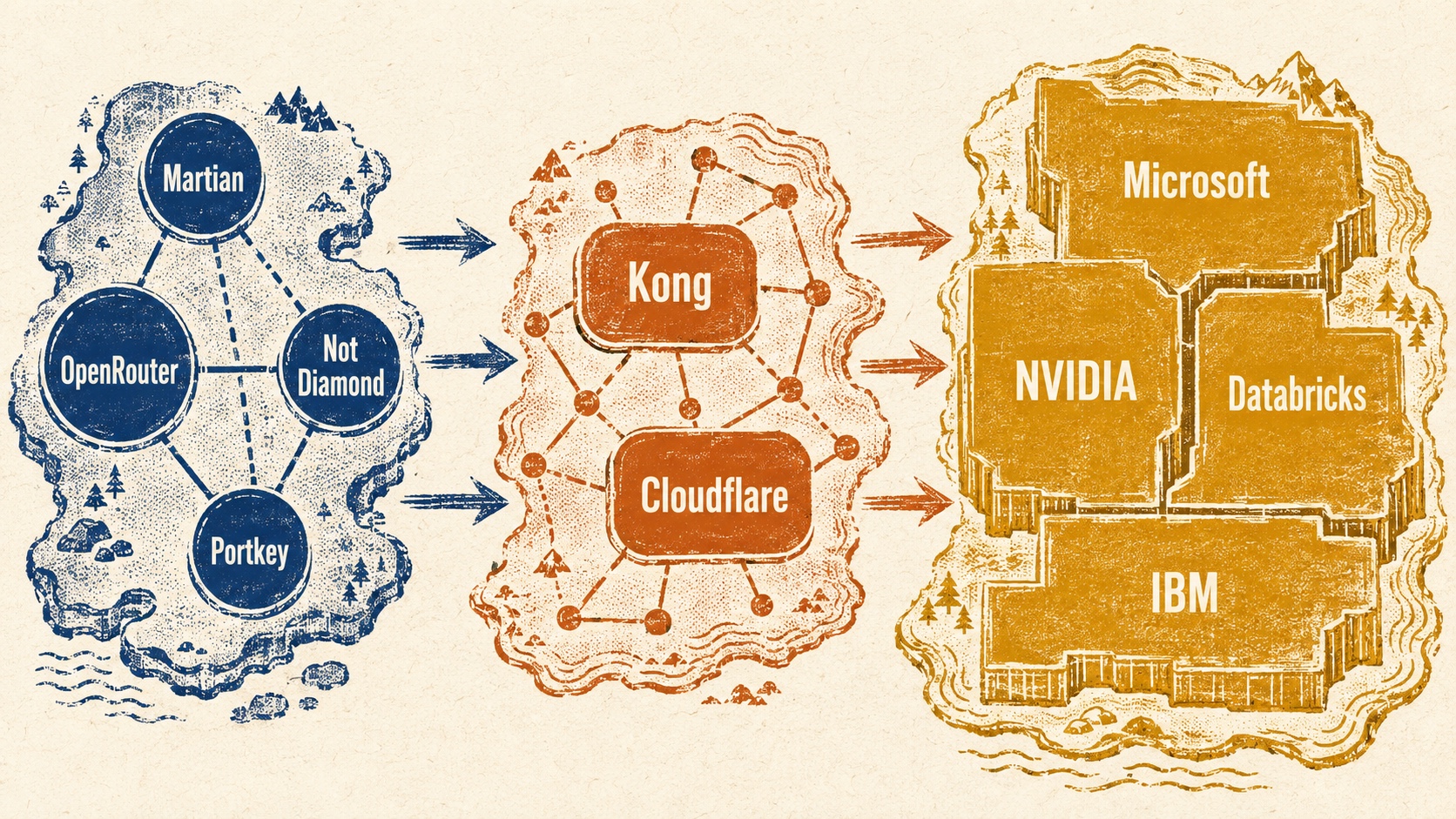
The competitive landscape reflects this. Specialized startups such as Martian, Not Diamond, OpenRouter, and Portkey have built their entire value proposition around neutral routing and lightweight SDKs (software development kits). Infrastructure incumbents are moving in the same direction: Kong and Cloudflare are extending their API gateway products to include AI routing functions, and Microsoft, NVIDIA, and Databricks have each announced orchestration capabilities within their enterprise platforms.
The implication for enterprise IT leaders is that model routing is transitioning from an experimental optimization technique to a standard component of AI infrastructure, roughly analogous to how load balancers became standard for web traffic in the 2000s.
Routing at the edge: beyond the data center
The routing logic applies beyond conventional enterprise software. Astute Analytica's 2026 report specifically identifies autonomous vehicles, healthcare, and industrial automation as high-priority deployment domains.
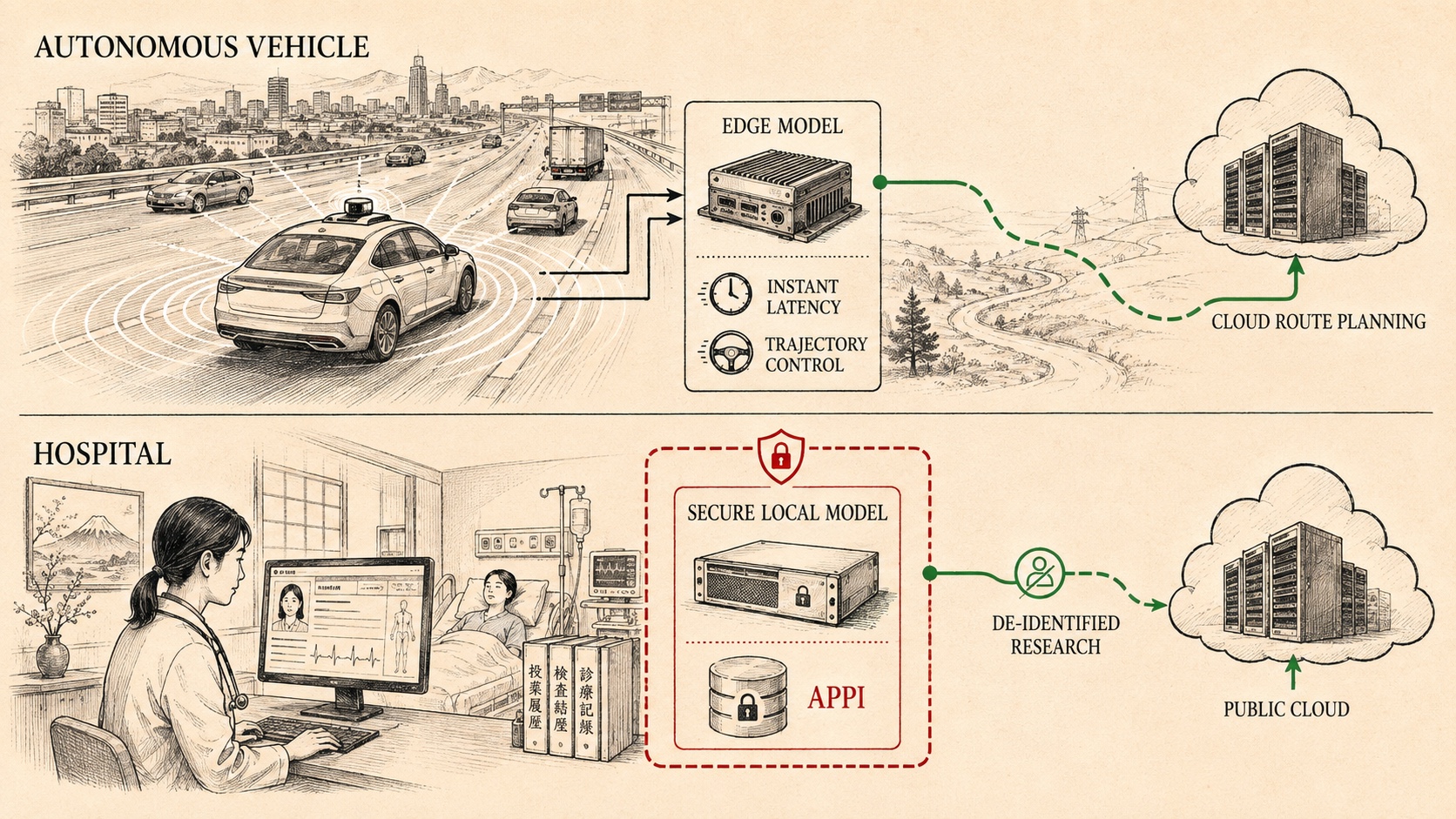
The pattern is consistent across them. An autonomous vehicle must process sensor data and make trajectory decisions in real time. Sending that data to a remote cloud model for inference introduces round-trip latency that is incompatible with safe vehicle control. An on-board edge model handles real-time object recognition and trajectory decisions; a cloud model handles route optimization and predictive maintenance analysis. The router determines which computation goes where.
In a hospital setting, a clinical decision support system may route patient-facing queries through a locally hosted model as a risk-control measure, reducing exposure to the data handling obligations that Japan's Act on the Protection of Personal Information (APPI) places on overseas transfers, such as ensuring equivalent data protection through contract, adequacy, or consent mechanisms. The same system routes de-identified research queries to a larger cloud model. The compliance logic, previously a manual policy enforced through user training, becomes a technical control embedded in the infrastructure.
This is the organizational value proposition that goes beyond the headline cost reduction: model routers convert informal data governance policies into enforceable system behavior.
What enterprise buyers should evaluate
The investment case for model routing covers three distinct categories, and the most visible one is rarely the most valuable.
Direct cost reduction is measurable: lower inference costs per query, reduced peak compute load, and smaller commitments to premium model providers once routing is calibrated to the actual workload.
Governance and risk reduction is harder to quantify but often carries more weight in regulated industries. When sensitive prompts are automatically redirected to compliant on-premises environments, the compliance outcome stops depending on user behavior. That shift from policy to technical control is worth real budget in any sector subject to data residency or confidentiality requirements.
Architectural flexibility is the long-term consideration that procurement teams tend to undervalue at the point of purchase. AI model performance and pricing move faster than enterprise contract cycles. A system built on a router abstraction can redirect spend toward better-performing or lower-cost models as the market shifts, without rebuilding the application stack.
The implementation risks are genuine. Routing decisions introduce computational overhead and latency that must be validated against the tolerances of specific workloads. Maintaining prompt format compatibility across model families requires ongoing engineering attention. Reproducibility requirements in some regulated domains may constrain how aggressively routing thresholds can be set.
Those risks are reasons to design the evaluation carefully, not to delay it.
The infrastructure decision that compounds
The Astute Analytica market forecast projects the AI model router market to grow at 44.9% annually through 2035. That growth rate reflects a broader economic inevitability: as AI query volumes scale across an organization, the cost of sub-optimal model allocation compounds. A compute efficiency gap that is tolerable at low query volumes becomes a budget crisis at enterprise scale.
Enterprises that establish routing infrastructure now gain two practical advantages. First, they build the telemetry to understand their workload composition, which is the prerequisite for optimizing routing thresholds over time. Second, they retain the option to shift spending between model providers as the market evolves, rather than discovering vendor dependency at renewal time.
The question for enterprise AI leaders is not whether model routing will become standard infrastructure. Given the cost dynamics, it is likely to. The question is whether the organization builds that capability before or after the compute bill forces the issue.
References
- Astute Analytica (August 13, 2026). *AI Model Router Market Forecast (2025–2035)*. Newscast Release
- LMSYS Org (July 1, 2024). *RouteLLM: An Open-Source Framework for Cost-Effective LLM Routing*. LMSYS Research Blog
- ITmedia Alternative Blog (Business 2.0 Perspective) (August 31, 2026). *Why the AI Model Router Market Is Expanding at 44.9% CAGR: Enterprise Strategy from Single-Model Dependency to Dynamic Optimization*. ITmedia Article
- Personal Information Protection Commission (PPC Japan). *Act on the Protection of Personal Information (APPI): Guidelines for Cross-Border Data Transfers*. PPC Japan Guidelines