One engineer now ships what three used to. Your bottleneck just moved.
In June 2026, VentureBeat ran a headline that stopped hiring managers mid-sentence: "Claude Code turned every engineer into three." The article argued that AI coding tools had compressed software production so much that the real constraint was no longer building features. It was deciding which features to build.
Anthropic's own internal research backs the direction, if not the exact multiplier. Engineers using Claude Code reported roughly 50% higher productivity and a 67% increase in merged pull requests. Whether the true number is 1.5x or 3x matters less than the structural consequence: production speed has outrun the organizations built to manage it.
The software industry noticed immediately. But the shift will not stay inside software. Every industry that produces anything, from marketing copy to financial reports to construction drawings, is about to feel the same compression.
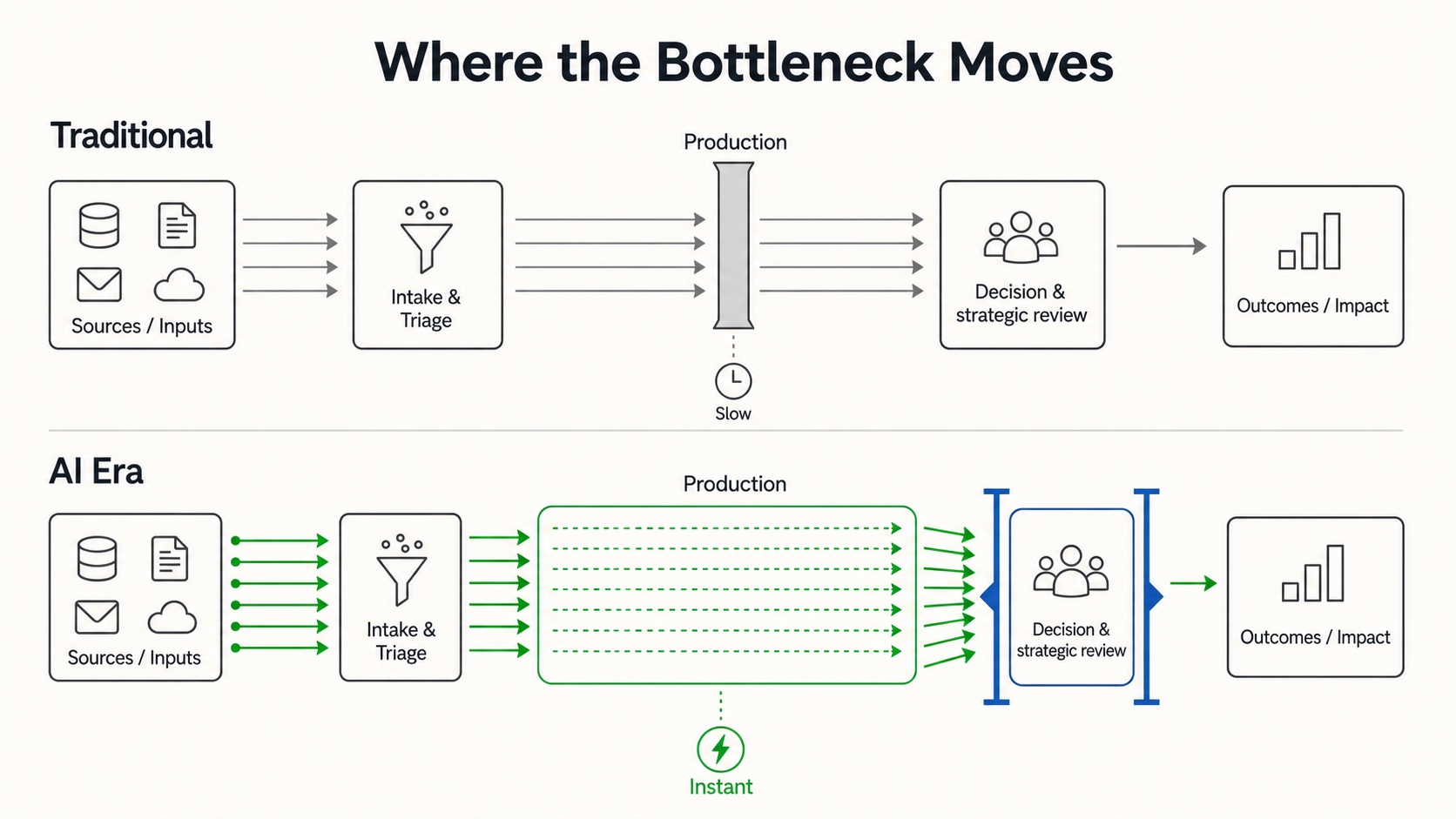
When production gets dramatically faster, the slowest part of the organization is no longer the people building things. It is the people deciding what to build.
The bottleneck has moved up the org chart
For decades, companies operated under a simple assumption: production is expensive and slow, so you need people whose entire job is to make sure every production cycle counts. Project managers wrote requirements. Business analysts translated business needs into specifications. Middle managers approved and prioritized.
That structure made sense when production was the constraint. A software team that could ship one feature per sprint needed tight coordination to avoid wasted effort.
AI has broken that equation. McKinsey reports that 76% of employees now use AI in some capacity at work, up from 30% in 2023. Production capacity has expanded so fast that the old coordination layer cannot keep pace.
Project managers are still writing two-week sprint plans for teams that can now deliver in two days. Business analysts are still producing 40-page requirements documents for features that an AI-assisted engineer can prototype in an afternoon. The coordination layer has become the constraint.
This is not a software-only problem
The pattern started in software because coding tools like Claude Code and GitHub Copilot made the shift visible first. But the same dynamic is showing up across industries.
A marketing team adopts AI content generation. A copywriter who used to produce three blog posts per week now produces twelve. The team leader who approved copy on a weekly cycle is suddenly reviewing four times the volume. The quarterly editorial calendar, built around the old production speed, becomes obsolete by the second week.
In legal, contract review is now faster than contract approval. In finance, analysis is faster than the committee meetings that act on it. In architecture, rendering is faster than client feedback cycles.
Gartner projects that by the end of 2026, one in five organizations will eliminate more than half of their middle management roles. That number sounds alarming, but it misses what is actually happening. Most of those roles are not being deleted. They are being replaced by something else entirely.
This is about retraining producers, not cutting managers
Most companies hear "middle management is the bottleneck" and start planning layoffs. That is the wrong response.
The real opportunity runs in the opposite direction: take the people who are now freed from repetitive production work and retrain them as decision-makers.
An engineer who has spent five years building features understands the product better than most product managers. A designer who has created hundreds of layouts understands user behavior in ways no specification document captures. An editor who has shaped thousands of articles knows what resonates with readers and what falls flat.
These people have deep domain expertise. What they lack is the explicit training to turn that expertise into strategic decisions: what to build next, which projects to prioritize, how to evaluate tradeoffs across the business.
The World Economic Forum's Future of Jobs Report 2025 estimates that 59% of workers globally will need training by 2030 to stay competitive. "Training" does not mean learning to write prompts. It means learning to make faster, better decisions with AI-produced inputs, and knowing when to override the machine.
IKEA proved the model before most companies even noticed
In 2021, Ingka Group (IKEA's largest franchisee) deployed an AI chatbot called Billie that could resolve 47% of customer service inquiries without human help.
Most companies would have used that number to justify cutting call center staff. IKEA retrained 8,500 call center workers into remote interior design advisors instead.
The business impact was concrete. By the end of fiscal year 2022, Ingka Group's remote customer meeting points, the new advisory channel built on these reskilled workers, reached EUR 1.3 billion in revenue. Customer satisfaction went up because trained humans handled the complex, high-value conversations that the chatbot could not.

Then the headline changed. In 2026, Ingka Group announced 800 office-based layoffs, followed by 850 more at Inter IKEA. The press treated it as proof that AI reskilling was a feel-good story that did not survive contact with reality.
That reading misses something important. IKEA's reskilling program in customer service worked and continued to work. The layoffs came from a different part of the business, driven by traditional cost pressures and market shifts. Reskilling solves a specific problem (what happens to production workers when production speeds up) and does not immunize a company from every other business challenge.
What makes IKEA's case worth studying is the structure of the bet. They did not move people into new seats and hope for the best. They invested in retraining programs that turned routine task workers into advisors who could make judgment calls, read customer needs, and recommend solutions. The workers moved from executing a script to making decisions. That is the transition every industry will need to make.
Why retraining is the critical investment
Only 1% of companies report achieving full AI maturity, according to McKinsey. The gap is not technology. 92% of companies plan to increase AI investment. The gap is human capability.
Less than 25% of employees receive any training before new AI tools are introduced. Only 24% of individual contributors feel their employer has adequately prepared them for AI integration. Gartner warns that over-reliance on AI without human skill development leads to "skills atrophy," where employees lose the reasoning abilities they need most.
The companies that will win the AI transition are not the ones that buy the best tools. They are the ones that retrain their people to use those tools for decisions, not just for production.
Three investments matter here:
First, move production workers into decision roles before cutting them. Engineers, designers, writers, and analysts already have domain knowledge. Give them decision-making frameworks, business context, and authority to act on AI-generated insights.
Second, redesign approval workflows for AI speed. If your team produces in two days what used to take two weeks, your review process cannot run on a two-week cycle. Compress decision loops to match production speed.
Third, measure decision quality, not just production output. When production is nearly free, the competitive advantage shifts to who makes better choices, faster. Track decision outcomes, not just throughput.
The farrier-to-mechanic comparison, updated
When the internal combustion engine replaced the horse, the farrier did not become useless. Farriers who adapted became mechanics. The ones who insisted they were in the horseshoe business disappeared.
AI follows the same pattern, compressed into years instead of decades. The production layer is being replaced by AI tools that work around the clock. The coordination layer is under pressure because the old cadence no longer applies.
The opportunity sits with the people who know the domain. The engineer who can now ship features at twice the pace does not need a project manager to allocate her time. She needs the skills and authority to decide which features matter most. The designer who can generate a hundred layout variations in an hour does not need a creative director to queue his work. He needs the judgment to choose the right variation and defend that choice to the business.
Retraining is how you get there. Not as a perk or an HR initiative, but as the central strategy for surviving the speed compression that AI creates.
What this means for your organization
If you lead a team that produces anything, the question is not whether AI will make production faster. It already has. The question is whether your people are ready to do the work that speed exposes: making decisions about what to build, what to cut, and what to bet on next.
The companies that treat AI as a chance to cut headcount will save money in the short term and lose institutional knowledge that takes years to rebuild. The companies that treat AI as a chance to promote their best producers into decision-making roles will build organizations that move at AI speed, with human judgment behind the wheel.
IKEA bet on the second path and built a billion-euro advisory channel from reskilled call center workers. Most enterprises have not yet made the same bet. Every quarter they wait, their best people are learning less, not more.