The problem no one told you about
A pattern keeps appearing across Artificial Intelligence (AI) pilots: a company deploys a chatbot on a general-purpose AI, asks it questions about internal processes, and gets answers that sound authoritative but are based on outdated internet data or, worse, invented content. The model was never trained on company-specific information, so it fills the gaps with whatever sounds plausible.
This is not a bug you can patch with a better prompt. It is a structural problem. And it has a structural fix.
The fix is called Retrieval-Augmented Generation (RAG). Instead of relying on what the model memorized during training, your company gives it a live connection to your own documents.
The open-book exam analogy
Think about two ways to prepare an analyst for a client meeting.
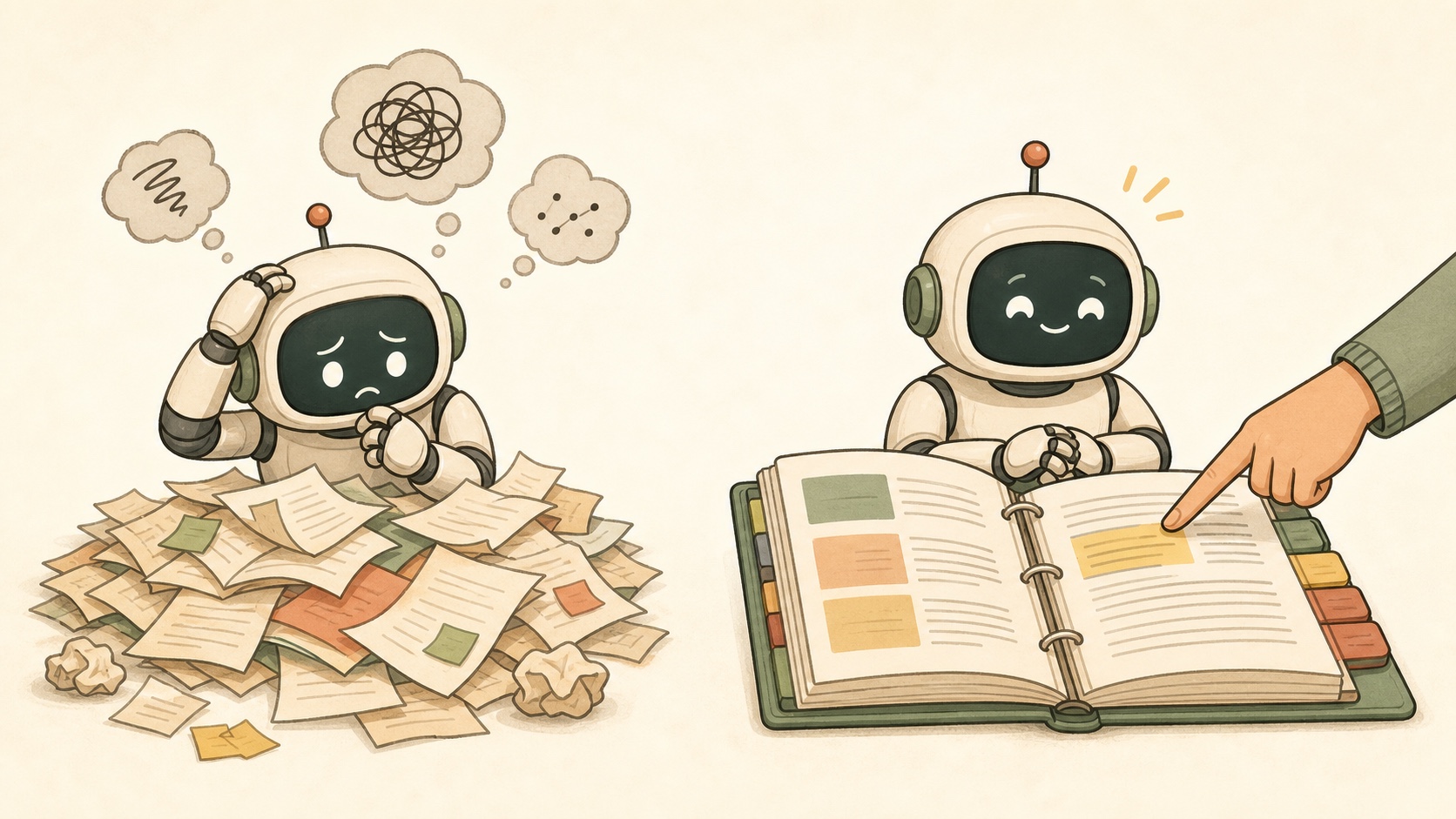
Option A: Closed-book. You ask the analyst to memorize everything before walking in, from company policy to product specs to last quarter's numbers. They do their best. But memory is fallible. Policies change. Numbers go stale. Under pressure, they fill gaps with confident-sounding guesses.
Option B: Open-book. You hand the analyst a folder with your latest policy manual, the relevant product documentation, and this week's financial summary. They reference the folder before answering. Most answers can be traced back to a specific page.
RAG is Option B. Instead of forcing the AI to guess from training data it absorbed months or years ago, your company builds a structured knowledge folder. When a question comes in, the AI searches that folder, retrieves the most relevant sections, and writes its answer based on those documents.
The output is more grounded and more current than what a model working from memory alone can provide.
Why "just use a smarter model" misses the point
The common reaction to AI mistakes is to reach for a better model. But model intelligence is not the bottleneck here. The bottleneck is that the model does not have access to *your* information.
A world-class surgeon cannot diagnose a patient they have never examined. A consultant cannot advise on a contract they have not read. Model capability and data access are separate problems. RAG solves the second one.
"But our AI already has a huge context window"
This question comes up often from executives who have heard that newer AI models can process enormous amounts of text in a single session.
A large context window and a properly built RAG system solve different problems. In most enterprise settings, you need both.
1. Security and access control
A large context window has no concept of who is asking. If you load your entire company knowledge base into a conversation, the AI sees all of it. A sales manager asking a question might inadvertently receive information from the legal team's privileged case files, or from another department's confidential strategy documents.
A RAG system can apply access controls at the retrieval step. Before any document reaches the AI, the system checks who is asking and filters accordingly. A sales manager's query only retrieves sales-appropriate documents. The legal files never enter the conversation. This is the kind of information governance your legal and compliance teams require.
2. Scale and cost
Large context windows are expensive to run. The computational cost scales significantly with the length of the input. At the scale of a real enterprise, with hundreds or thousands of employees querying the system daily, loading the full document library into every conversation becomes economically unsustainable.
RAG retrieves only what is relevant. A query about expense reimbursement pulls two or three policy paragraphs, not the full 200-page Human Resources (HR) handbook. Costs stay manageable. Response times stay fast.
3. Reliability across a large document library
Research has consistently shown that AI models struggle with information buried in the middle of very long inputs. They tend to favor content at the beginning and end. Load 500 pages of documentation into a single session and the AI may miss a critical clause on page 243.
RAG does not read linearly. It searches, scores relevance, and retrieves the specific chunks that match the question. The AI reads only those chunks.
4. Shared memory across the organization
A context window holds memory for one conversation. It resets when the session ends. Every new employee who asks a question starts from zero.
A RAG system is shared organizational memory. Every team member draws from the same knowledge base, regardless of session. Once a document update has been indexed, everyone gets the updated answer on the next query. This is what makes AI usable at an organizational scale, not just for individual productivity.
What a company RAG system looks like in practice
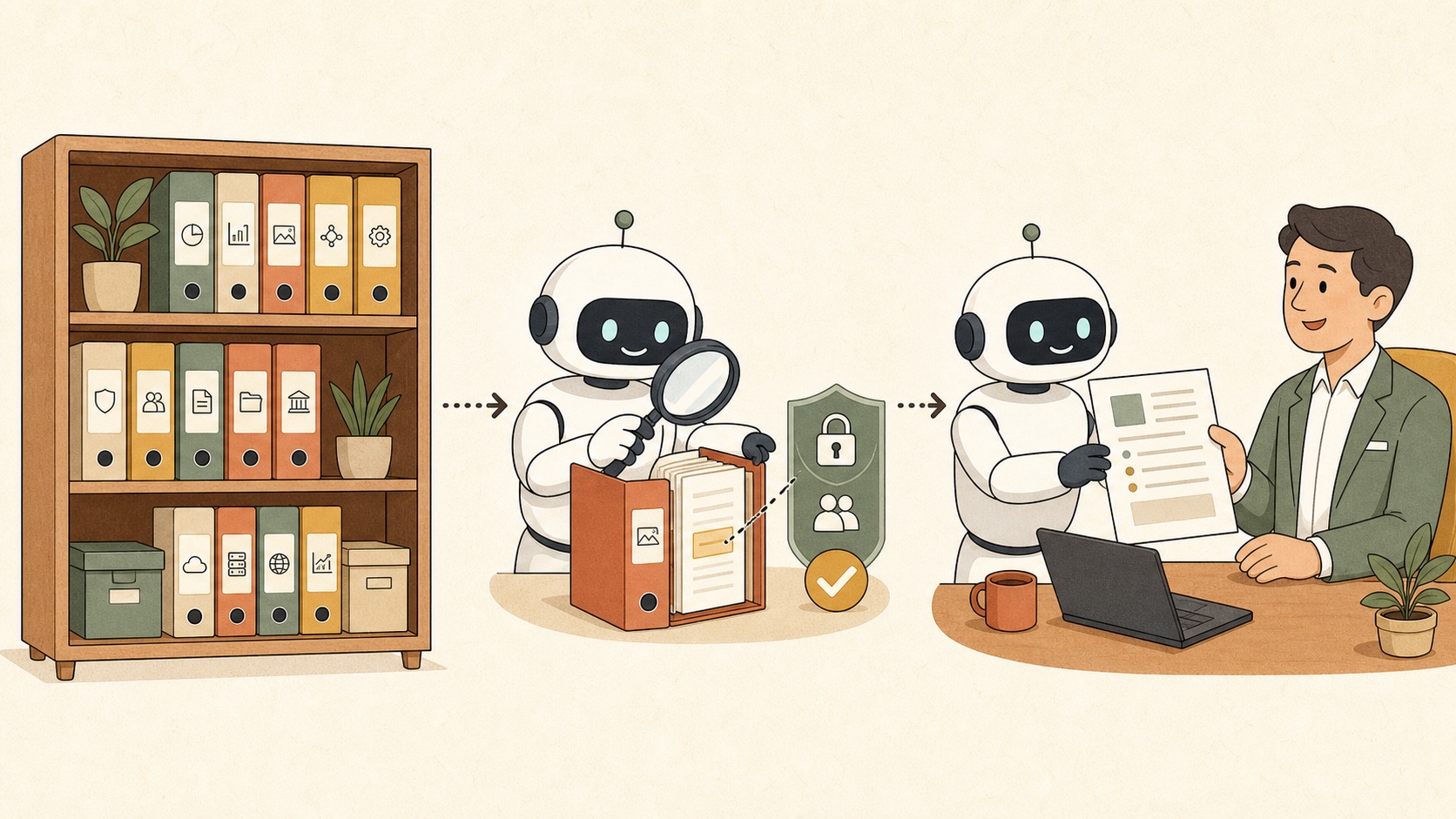
A RAG system for your organization involves three layers. None of them require engineering expertise to understand.
Layer 1: The knowledge library
This is where your company's documents live. It can include policy manuals, product documentation, contracts, internal wikis, and approved process guides. The quality of your RAG output depends directly on the quality of this library.
Documents are broken into structured sections and indexed so the system can search them quickly. Think of it as organizing the filing cabinet before teaching the AI where everything is kept.
Three examples of how companies use this layer:
- A law firm indexes active case research, jurisdiction-specific regulations, and precedent summaries. The AI answers associate queries without accessing unrelated client files.
- A manufacturing company indexes equipment manuals, quality standards, and maintenance procedures. Floor supervisors get answers during production without calling the central office.
- A financial services firm indexes compliance guidelines, approved product terms, and internal risk policies. Customer-facing staff can answer regulatory questions without escalation.
Layer 2: The retrieval engine
When a question comes in, the retrieval engine searches the library and scores which sections are most relevant. It returns a small, focused set of document sections, not the whole library.
Access controls sit here. The retrieval engine checks the user's role and filters results to only what they are permitted to see.
Layer 3: The AI's answer generation
The AI receives the retrieved sections and the original question. It writes an answer based on what it was given. A well-configured system will say when the answer is not supported by the retrieved documents, rather than inventing one. RAG reduces the chance of invented answers, but the quality of the output still depends on the quality of the documents retrieved.
Keeping the knowledge base current
A knowledge base that falls behind is a liability. An employee who trusts the AI's answer does not think to double-check. If that answer is based on a policy revised six months ago, the error moves silently through the organization.
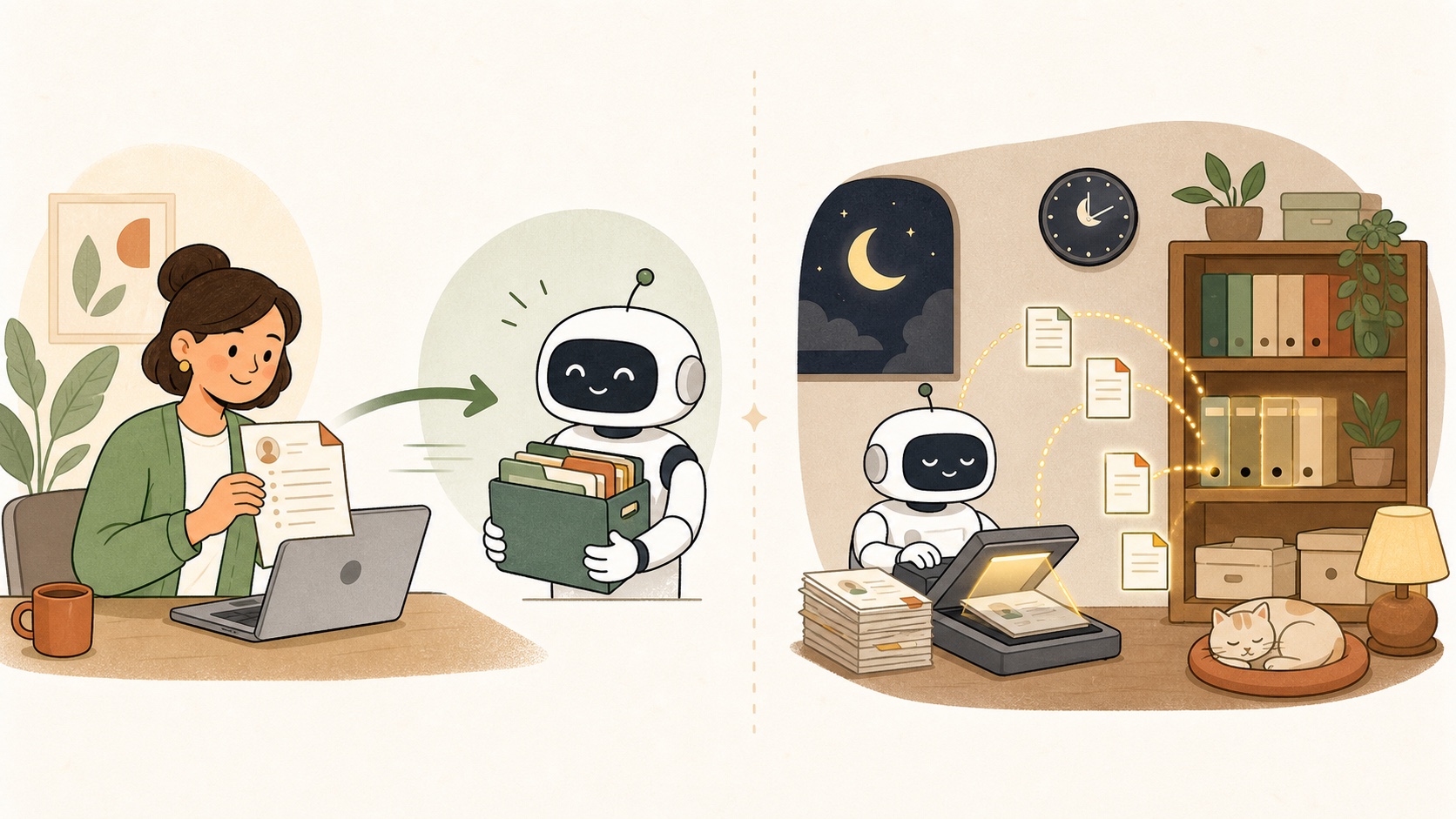
Most organizations use a combination of two update approaches.
Approach 1: Event-triggered updates
When a document changes in your system, the knowledge base updates immediately. Your HR team posts a revised expense policy to your company drive and that change triggers an automatic re-indexing. By the time the next employee asks about reimbursements, the AI is drawing from the new version.
This approach requires a connection between your document storage and the RAG pipeline. It is the right choice for fast-changing operational content.
Approach 2: Scheduled batch updates
For content that changes less frequently, an indexing job runs on a set cycle, perhaps nightly or weekly. The system scans for changes and updates only the affected sections.
This works well for product documentation, compliance references, and other content where same-day accuracy is less critical.
Document governance habits that matter
The technology is only part of the answer. The organizational habits behind it matter just as much:
- Assign a document owner for every knowledge category. When a policy changes, that person is responsible for updating the source document.
- Set expiry dates on time-sensitive content. A promotional pricing document from last quarter should not still be answering questions this quarter.
- Run monthly accuracy audits. Ask the AI your ten most common internal questions. Check whether the answers are still correct.
- Keep a source-of-truth hierarchy. When two documents conflict, which takes precedence? The RAG system should reflect that hierarchy.
The privacy and compliance question
Executives in regulated industries ask the right question: does building a RAG system mean sending company documents to an external AI provider?
The answer depends on how the system is designed.
In a RAG architecture, the retrieval engine extracts the most relevant text sections from your document library for each query. That retrieved content is then sent to the AI model along with the user's question. If the AI model is hosted externally, those retrieved sections do leave your internal environment.
For organizations with strict data handling requirements, such as those in finance, healthcare, or legal services, this matters. The most common enterprise responses are:
- Private cloud deployment: The AI model runs within the organization's own cloud environment, under the organization's own security policies.
- On-premises deployment: The entire system runs on hardware the organization controls directly.
- Vendor data processing agreements: The organization uses a commercial AI provider under a contract that defines how data is handled, who can access it, and how long it is retained.
RAG architecture alone does not determine your compliance posture. What determines it is the combination of deployment environment, vendor agreements, data classification, access controls, and retention policies. What RAG does is give you control over which documents are retrievable and by whom, which is where that conversation has to start.
The honest summary
RAG is not a feature. It is an architectural decision. The difference between an AI that draws from your company's own documents and one working entirely from training memory is almost always this decision.
RAG reduces the rate of invented or outdated answers, but its reliability depends on one thing: the quality and currency of the knowledge library behind it. A well-maintained, governed document library produces useful, traceable answers. A poorly maintained one produces confident-sounding errors from a different source.
Companies that get real value from AI typically share a common pattern: they treated their internal knowledge as infrastructure and connected it to their AI systems with the right controls in place. Model choice matters far less than the quality of the knowledge behind it.
If your AI deployment does not have a structured knowledge layer behind it, you are running a closed-book exam. The model will do its best with what it knows. But it has never read your company's policies, and it cannot know what changed last month.