Corporate marketing leaders face a fundamental shift in how consumers discover and purchase products. According to Klook's 2026 Travel Pulse Survey of Asia-Pacific travelers, presented at the Meet Startup conference in August 2026, 91% of travelers had used artificial intelligence (AI) to plan trips, and 36% had completed bookings directly following AI recommendations. As consumers increasingly delegate product evaluation to conversational systems, traditional digital marketing funnels are experiencing structural friction.
For years, commercial visibility rested on an established playbook: buy sponsored placements on search engines, run display campaigns across Social Networking Services (SNS), and direct human traffic to proprietary web storefronts.
This model is encountering limits because conversational engines like Google AI Overviews, ChatGPT, and Perplexity evaluate information differently from human shoppers. Rather than navigating visual advertisements or scrolling social feeds, AI models parse structured data, audit technical specifications, and cross-reference third-party feedback to synthesize direct recommendations.
Investing capital into broad social media campaigns while neglecting data infrastructure creates an imbalance in corporate capital allocation. In the emerging era of Generative Engine Optimization (GEO) and agentic commerce, commercial advantage belongs to companies whose product data is transparent, machine-readable, and accessible to AI search bots.
The structural breakdown of traditional web traffic
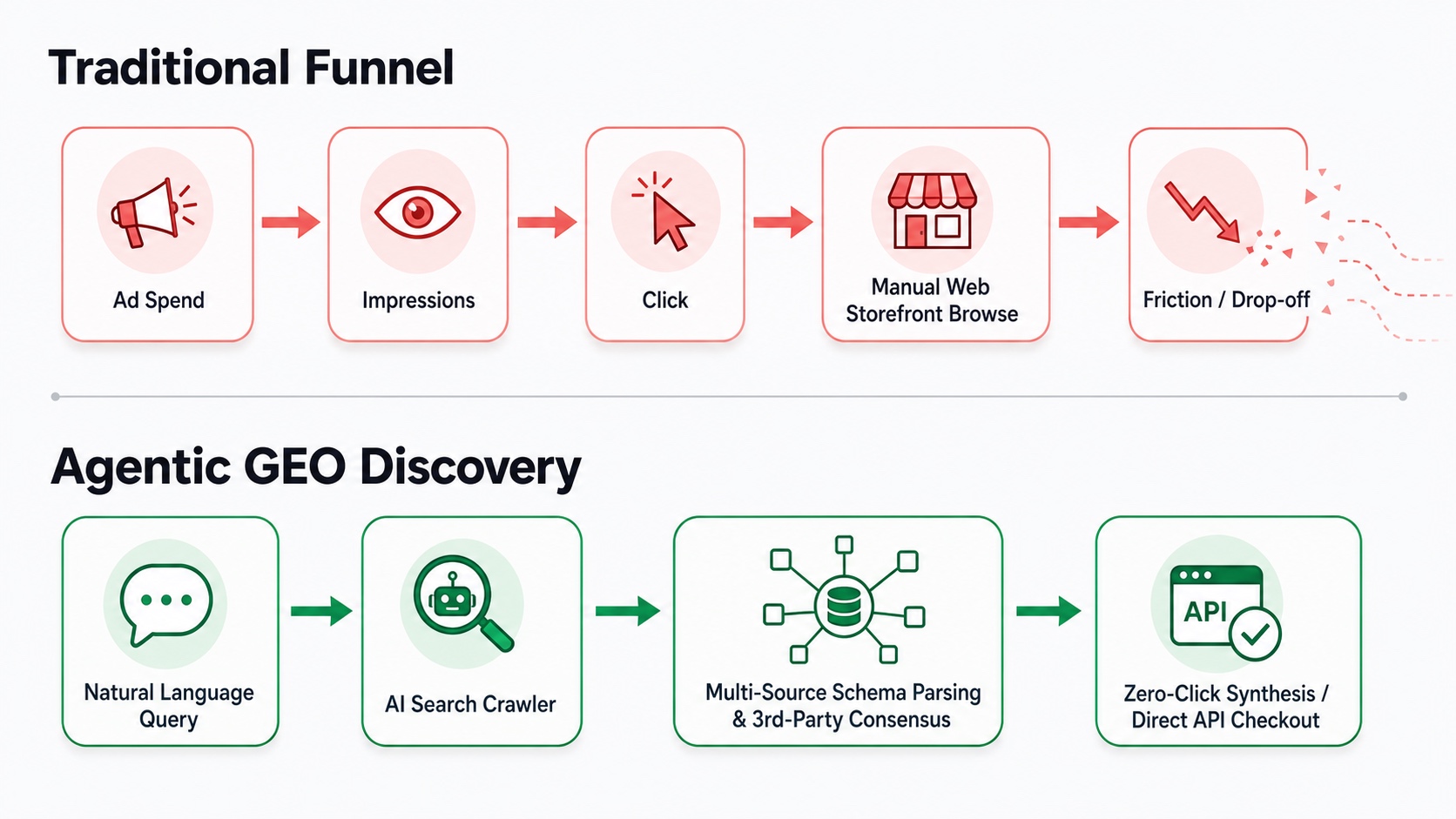
The decline of conventional search traffic represents an operational shift in consumer discovery patterns. When a user asks an AI assistant to recommend an air conditioner for a 350-square-foot room or assemble a compatible personal computer within a specific budget, the system returns a synthesized recommendation rather than a list of external links.
This transition alters the primary points of commercial influence:
- Zero-click synthesis: Conversational engines answer product inquiries directly within the chat interface, reducing the necessity for users to visit individual brand websites.
- Parameter-driven selection: Conversational systems evaluate structured attributes like dimensional compatibility, power requirements, and verified inventory over promotional copy.
- Channel divergence: Paid social media advertising captures human visual attention, but conversational search engines bypass these channels entirely when querying product databases.
As purchase evaluation becomes increasingly mediated by software agents, traditional marketing metrics such as impressions and raw click-through rates provide less visibility into actual commercial conversion.
Expanding technical foundations from SEO to GEO
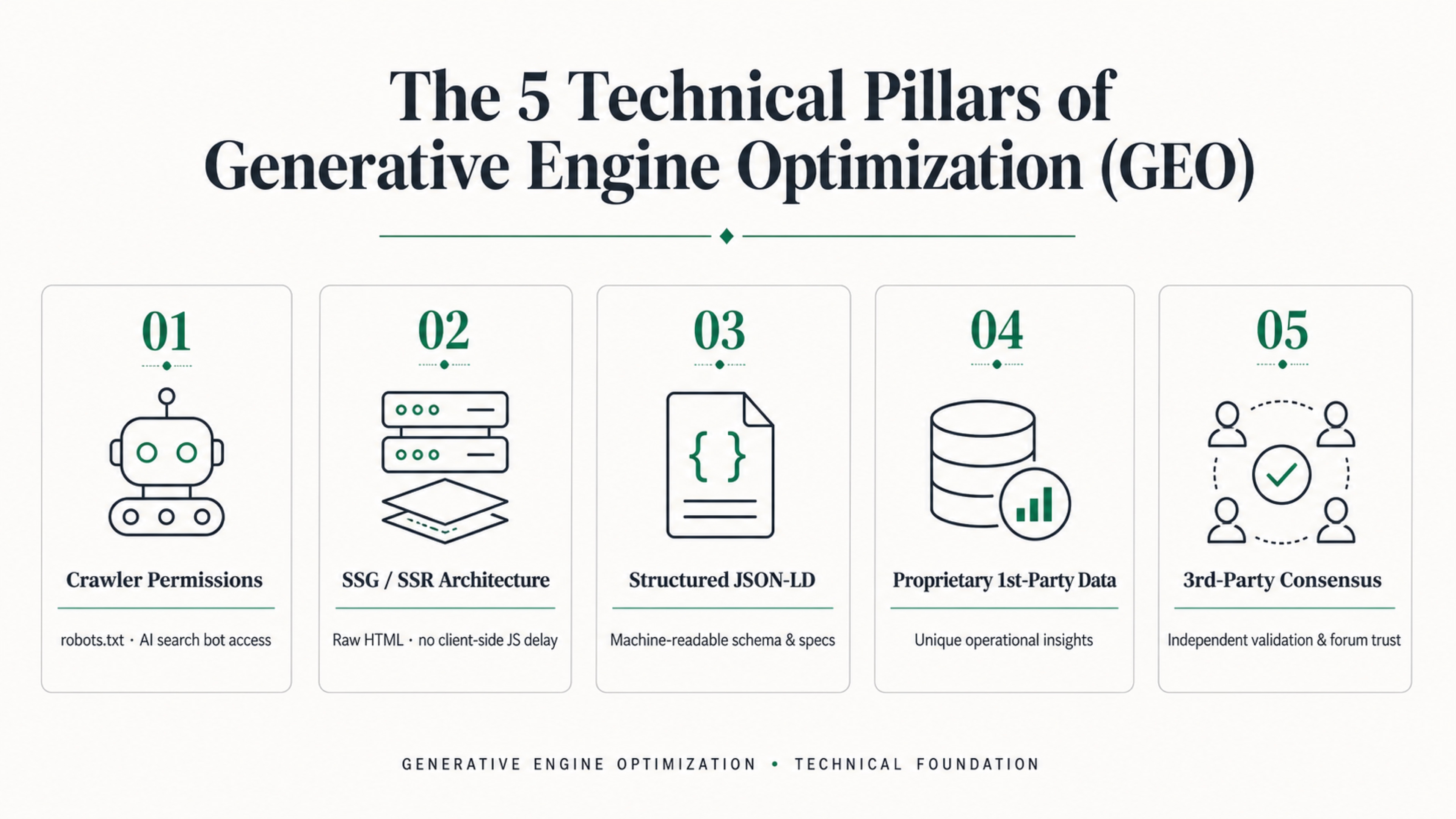
Achieving visibility in conversational search requires expanding technical Search Engine Optimization (SEO) into Generative Engine Optimization (GEO).
Traditional technical SEO established the core principles of indexability, structured metadata, and fast site performance. GEO builds directly upon these foundations, extending optimization from search engine ranking to multi-source synthesis and citation share across Large Language Models (LLMs).
Developing high machine legibility requires addressing several critical technical and architectural foundations:
- AI search crawler permissions: Corporate firewalls and robots.txt configuration files sometimes restrict automated user-agents. Ensuring appropriate crawl permissions for search and retrieval bots such as Googlebot, OAI-SearchBot, and PerplexityBot allows models that rely on live web indexing to discover and reference current catalog data.
- Addressing client-side rendering latency: Web applications built with React, often using tools such as Vite, frequently rely on Client-Side Rendering (CSR). In a pure CSR architecture, the server delivers an empty Hypertext Markup Language (HTML) shell that depends on client-side JavaScript execution to render content. While search crawlers like Googlebot can process JavaScript, client-side execution introduces rendering delays and indexing overhead for real-time retrieval systems. When configured to render and refresh catalog data, Server-Side Rendering (SSR) or Static Site Generation (SSG) can place product specifications and pricing directly in the initial HTML payload.
- Structured technical schema: Publishing machine-readable Schema markup in JavaScript Object Notation for Linked Data (JSON-LD) format, including explicit product dimensions, power requirements, warranty terms, and standardized question-and-answer blocks.
- Proprietary first-party data: Supplying unique operational insights that AI cannot extract from generic public web sources. For example, Klook integrates traveler booking-time preferences and extensive customer reviews directly into its product listings, providing search bots with differentiated context that generic ticket resellers lack.
- Third-party consensus: AI models evaluate factual claims by cross-referencing brand web pages with independent discussions on forums, technical publications, and consumer review platforms. A claim published solely on a corporate website carries lower confidence if independent sources do not validate it.
When an AI crawler cannot access a website, reliably parse its dynamic JavaScript, interpret its product specifications, or verify its claims through third-party consensus, the brand is significantly less likely to be cited or recommended in conversational query results.
The rise of agent-to-user interfaces and agentic commerce
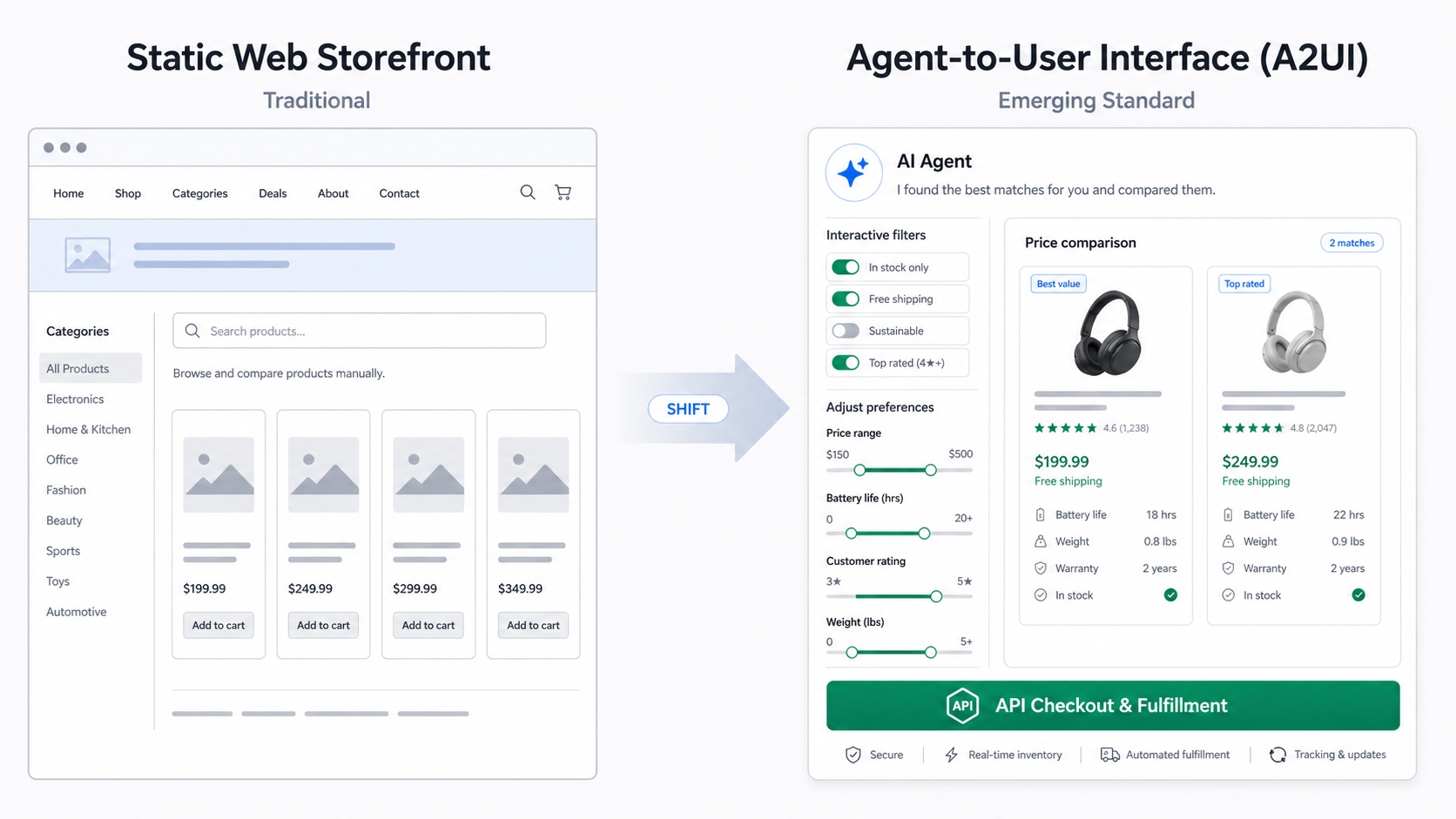
The transformation of commercial transactions extends beyond text-based chat assistants into automated execution.
Standardized consumer commodities such as household goods, packaged beverages, and basic electronics represent the initial phase of automated procurement. Because product specifications across retailers are largely identical, software agents can compare prices across vendors, select the most cost-effective option, populate digital shopping carts, and execute payments via Application Programming Interfaces (APIs).
For complex purchases like multi-destination travel itineraries or custom computing hardware, text summaries can be inefficient for decision-making. To address this, software developers are introducing the Agent-to-User Interface (A2UI).
Instead of displaying fixed web pages, the AI agent generates a dynamic, interactive comparison interface on demand. Users can adjust parameters, filter constraints, and confirm options directly within the generated component. As BigGo Chief Executive Officer (CEO) Kevin Yen projected during the Meet Startup #185 gathering in August 2026, A2UI technology is expected to reach commercial maturity around 2027, potentially restructuring how consumers interact with digital storefronts.
The durable moat: data APIs and physical logistics
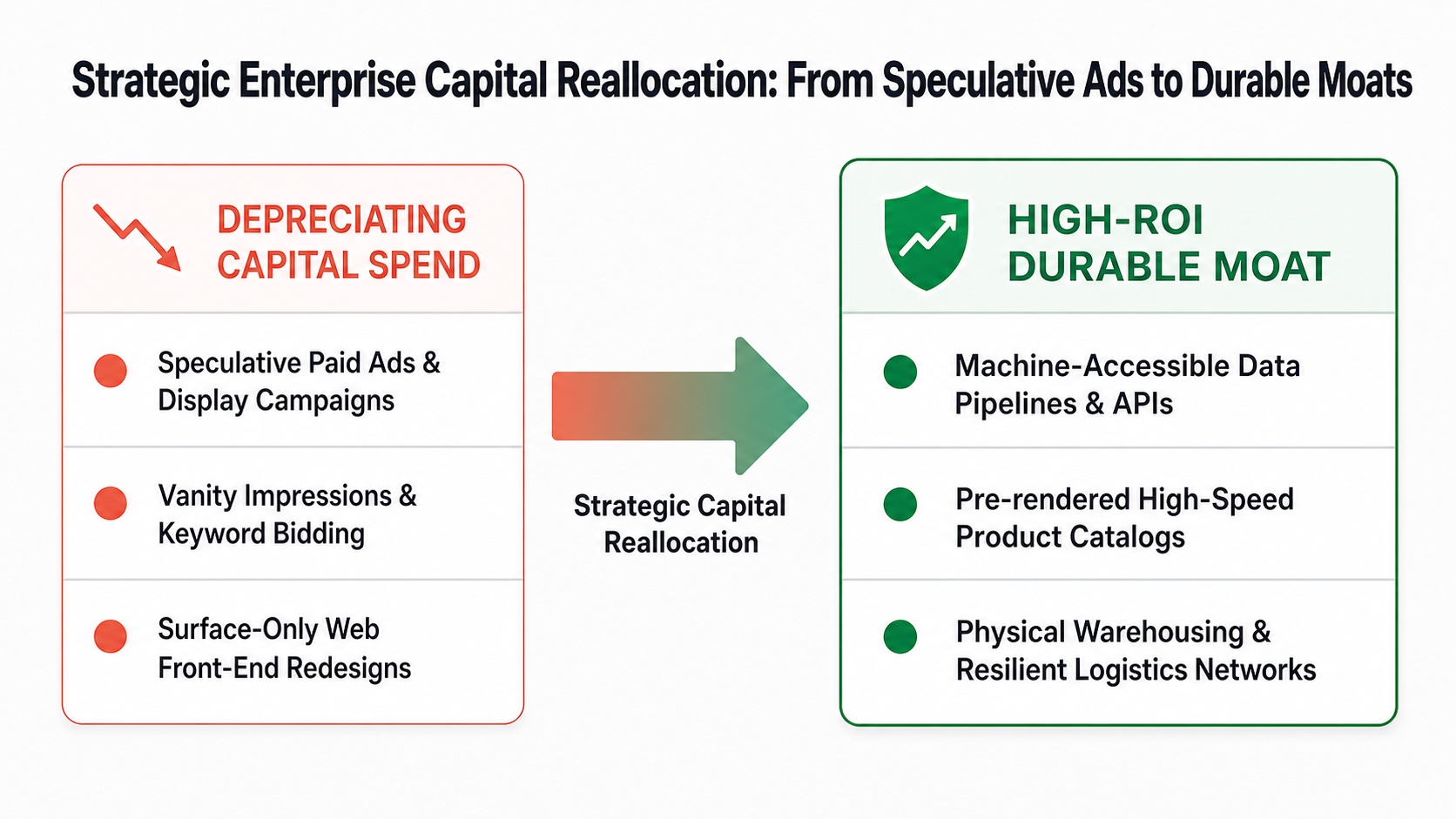
When software agents handle discovery, comparative analysis, and checkout, traditional e-commerce web portals face potential disintermediation. If consumers increasingly interact with AI intermediaries rather than browsing web pages directly, digital commerce teams must evaluate whether front-end design enhancements alone are sufficient without parallel investments in API connectivity and data accuracy.
In this restructured operating environment, long-term commercial value concentrates in two areas:
- Machine-accessible data pipelines: Maintaining high-speed APIs, real-time inventory feeds, and structured product databases that allow AI bots to discover and process transactions seamlessly.
- Physical operational assets: While AI agents can synthesize purchasing decisions rapidly, physical goods must still move through real warehouses, regional fulfillment hubs, and delivery networks.
Organizations that allocate marketing capital predominantly to speculative advertising campaigns risk losing visibility in automated discovery channels. The strategic priority for enterprise executives is clear: reallocate resources toward machine-readable data infrastructure, pre-rendered technical catalogs, and reliable physical fulfillment capabilities.
References
- Meet Startup: When AI Takes Over Shopping Gateways, Brands Must Be Recommended, Not Just Seen (Business Next Media, August 27, 2026, by Harper Chen, covering Meet Startup #185 with speakers Kevin Yen of BigGo, Phoenix Chen of Klook, Elaine Huang of Newegg, and Uma Chang of Raccoon AI)