The pilot trap
Most enterprise generative artificial intelligence (AI) initiatives fail to deliver business value. RAND notes that, by some estimates, more than 80% of AI projects fail outright. MIT's Project NANDA report ("The GenAI Divide," July 2025) found that 95% of organisations saw zero measurable return on their generative AI investments, despite corporate spending reaching an estimated \$30 to \$40 billion. Gartner reported in a January 2026 review that at least 50% of generative AI projects had been abandoned after proof of concept by the end of 2025. The specifics vary by methodology, but the direction is consistent. Organisations subscribe to a chatbot, distribute logins, instruct staff to "use AI for efficiency," and wait for returns that often fail to materialise.
While some initiatives falter because a task exceeds current model capabilities, many enterprise breakdowns are structural. Companies are treating a capital-allocation decision as a procurement transaction, purchasing a subscription instead of building an operating capability. The result is a widening gap between firms that deploy AI as a vending machine and those that are engineering the conditions for AI to produce reliable, organisation-specific work.
What the labour market already knows
PwC's 2026 AI Jobs Barometer, released in June, reported that United Kingdom (UK) job postings for specialist AI roles rose 61% year-on-year, from approximately 112,000 in 2024 to nearly 180,000 in 2025. The wage premium for AI-skilled workers tripled in a single year, climbing to 34.2%, up from 11% in 2024, and reaching as high as 64% in sectors such as consumer markets.
Demand is increasingly driven by specialists who can build and maintain the information architecture that surrounds a large language model (LLM): the retrieval pipelines, the permission boundaries, the memory systems, the tool definitions, and the governance rules that determine whether an AI agent produces trustworthy output or expensive noise.
PwC's UK analysis also documented a two-track labour market. Roles enhanced by AI grew 39% since 2018, compared to 17% for positions where technology primarily simplifies routine tasks. The economic premium goes to those who direct the machine and govern its context, not those who press a button and hope.
From prompt engineering to context engineering
The terminology and focus have evolved. In the earlier stages of generative AI adoption, industry discussion focused heavily on "prompt engineering." More recently, architectural attention has increasingly centered on "context engineering."
Tobie Morgan Hitchcock, chief executive officer (CEO) and co-founder of the database company SurrealDB, drew the line in a TechRadar analysis published in August 2026. Prompt engineering, he argued, concerns itself with how to phrase a question. Context engineering concerns itself with the operating environment in which the AI receives and processes that question: what data it has access to, what rules constrain its behaviour, what memory it retains from prior interactions, and what tools it can invoke to verify its own reasoning.
The distinction matters because it exposes the structural inadequacy of the chatbot subscription model. A chatbot subscription gives an organisation a model endpoint. It does not give the organisation a data pipeline, a retrieval architecture, a permission framework, or an orchestration layer. These are the components that determine whether AI output is accurate, relevant, and safe for the business to act upon.
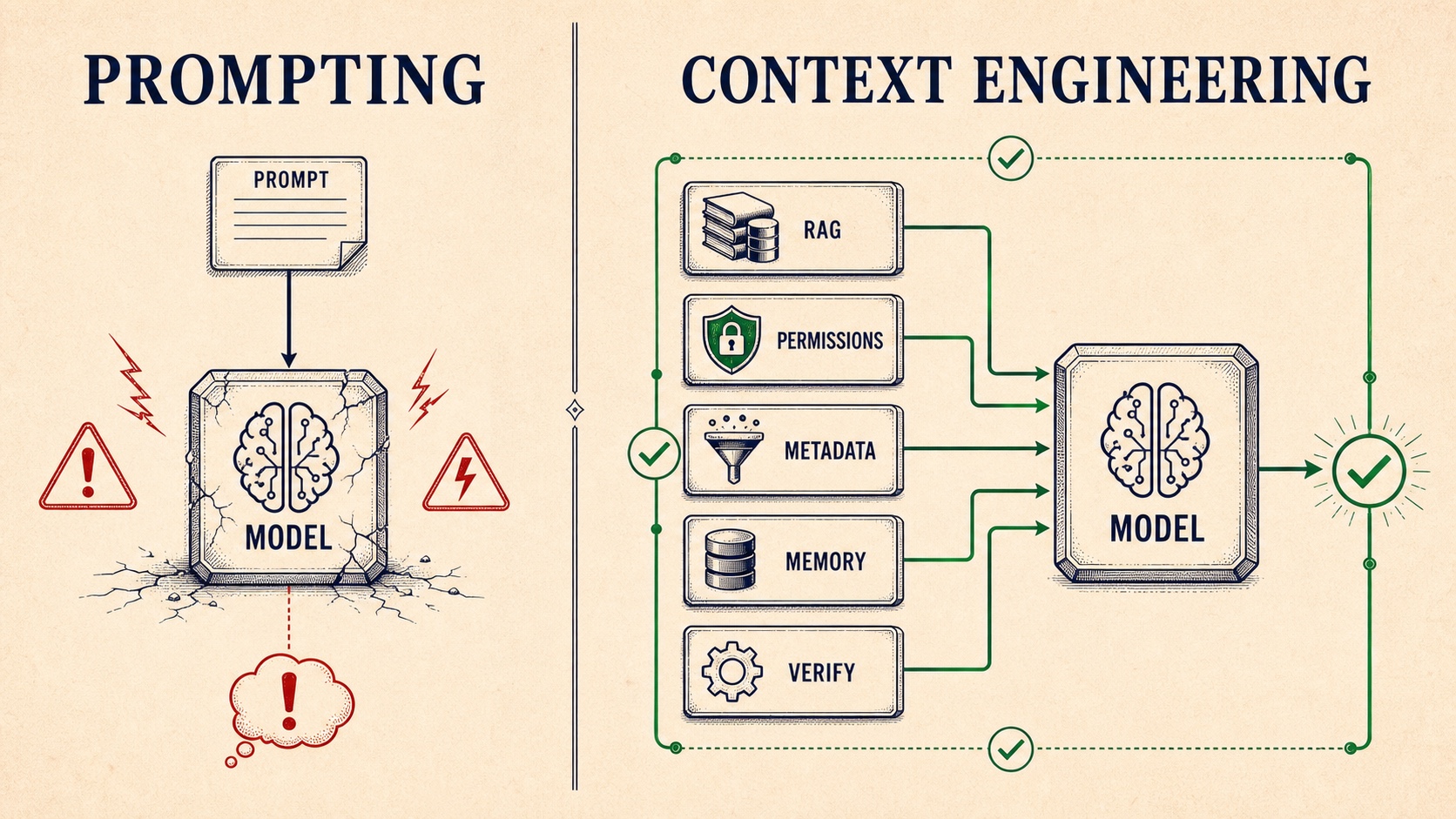
In Hitchcock's view, as AI moves into production, operational breakdowns are often driven by contextual issues: obsolete documents, missing schema metadata, or noisy retrieval windows. The fix is not a better prompt. The fix is a better information architecture.
The one-way answer machine trap
Consider a common enterprise scenario. A company subscribes to a commercial chatbot and connects it to a few internal documents. Employees begin asking questions. The chatbot produces answers that are plausible, occasionally useful, and impossible to verify against the company's actual knowledge base with any consistency. No retrieval pipeline indexes the latest internal documents. No permission system restricts what the model sees. No orchestration layer routes different types of queries to different specialised models or tools.
This is what can be described as the "one-way answer machine": a system that generates output without the organisational infrastructure to make that output reliable. Companies that remain at this stage are consuming tokens without compounding value. They have purchased access to generation capacity without investing in the context layer that makes generation productive.
A growing number of forward-looking organisations are taking a different route. They are seeking context engineers who understand data flow, retrieval systems, and access control, as well as AI orchestrators who design multi-agent workflows with human review at decision points. In short, they treat AI integration as an architecture project, not a software subscription.
The capital allocation question
From an economic perspective, raw text generation has become increasingly accessible, but generation is only one part of the equation. The scarce resource is the human judgment required to design the context in which that generation occurs: which data to retrieve, which rules to enforce, which outputs to trust, and which to discard.
Companies that invest only in the abundant resource (generation) while neglecting the scarce resource (context design) will discover that they have optimised for the wrong side of the equation. They will have a fast machine producing output that no one in the organisation trusts or uses.
Realising productivity gains from AI does not mean reducing headcounts or distributing generic chat seats. It requires reshaping what humans do, shifting work from routine execution to context design, quality assurance, and strategic oversight.
What a real AI strategy requires
The chatbot subscription is not the strategy. It is one component of a larger architecture that most organisations have not yet built. A functional AI strategy for 2026 and beyond includes at least three layers.
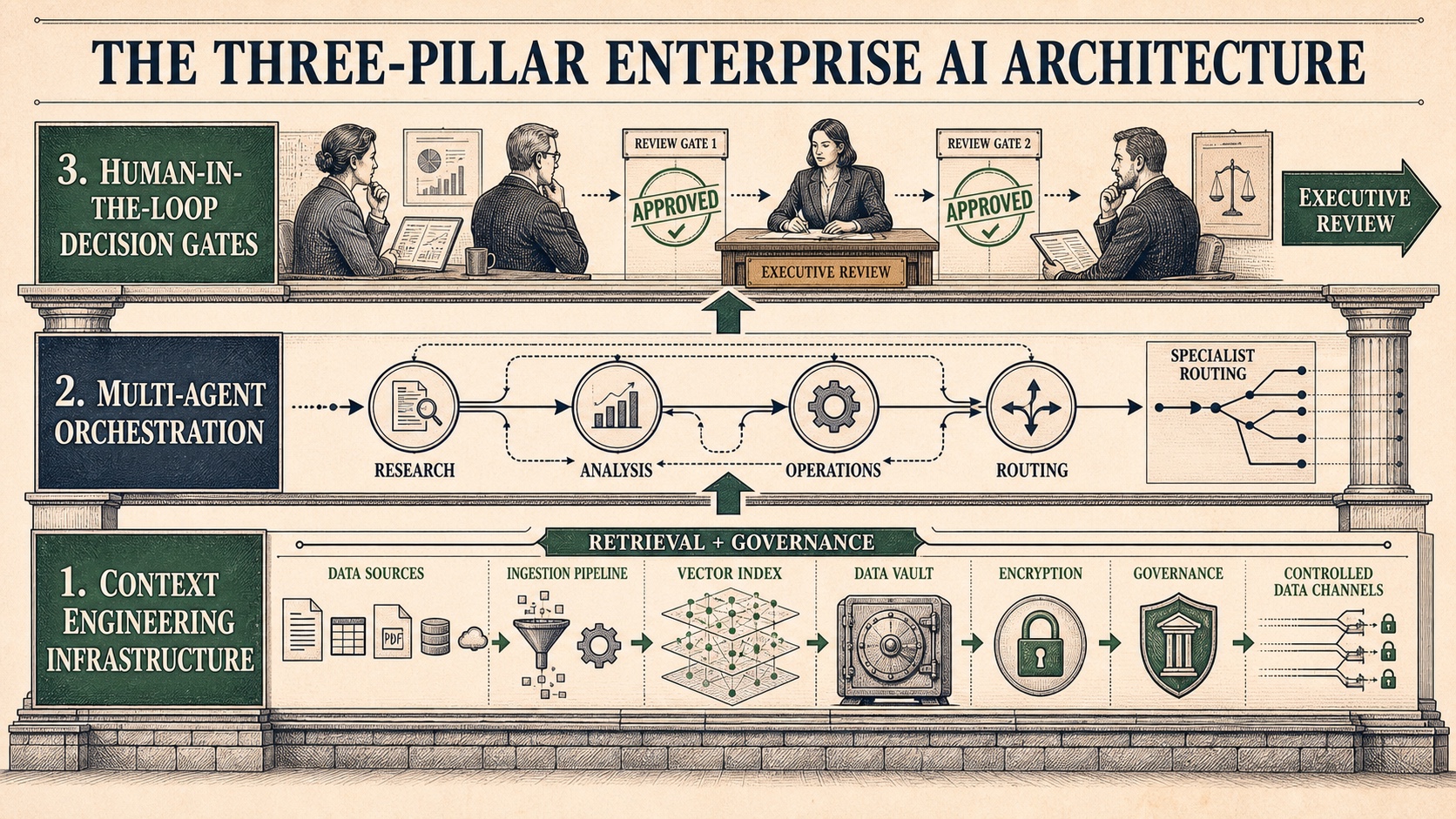
First, a context engineering capability. Someone in the organisation must own the information architecture that feeds the AI: the retrieval pipelines that pull the right data at the right time, the structured metadata that helps the model distinguish between current policy documents and obsolete drafts, and the governance rules that prevent sensitive data from leaking into uncontrolled outputs.
Second, an AI orchestration capability. As organisations move from single-chatbot deployments to multi-agent systems (where different AI models handle research, drafting, analysis, and verification as distinct steps), they need people who can design and maintain these workflows. This is not a technical curiosity. It is how reliable AI output is produced at scale.
Third, a human-in-the-loop integration model. PwC's findings on AI-enhanced roles show that enterprise value concentrates where humans exercise judgment at key decision points, rather than in purely autonomous execution. The orchestration layer must include clear insertion points for human review, approval, and correction.
The cost of waiting
The wage premium data carries a warning. With the specialist UK wage premium tripling to 34.2% in a single year (per PwC), the cost of acquiring AI talent is already substantial. If demand continues to outstrip supply, companies that delay building internal context engineering and orchestration capabilities risk a compounding disadvantage: paying more to hire scarce talent later, while competitors who invested earlier will already have their systems running and improving.
The chatbot subscription is the modern equivalent of buying a fax machine and calling it a communications strategy. It addresses the surface of the problem while ignoring the infrastructure beneath it. The organisations that pull ahead in 2026 and beyond will be those that recognise AI integration as an architecture discipline, not a procurement line item.