Imagine a global e-commerce platform experiencing a sudden, unexpected surge in order cancellations during a midnight holiday promotion. Historically, this scenario triggered chaos: paging customer support managers, waking up database administrators, and delaying customer refunds for days. Today, a single autonomous agent detects the anomaly, coordinates with a database-repair agent to resolve the system bottleneck, processes thousands of customer refunds in seconds, and drafts a comprehensive incident briefing for the executive team before sunrise. Not a single human employee was disturbed. This is not science fiction. It is the operational reality of the virtual employee wave of 2026.
The corporate landscape of 2026 is witnessing a rapid evolution in organizational design. According to Gartner, 40% of enterprise applications will be integrated with task-specific AI agents by the end of 2026, up from less than 5% in 2025. Often operating as virtual employees, these autonomous agents allow early-adopting organizations to achieve substantial improvements in operational leverage. Organizations that delay adoption, however, risk falling behind in operational efficiency and responsiveness.
This transformation goes far beyond simple software automation. It represents the rise of the virtual employee, a software agent capable of planning, reasoning, and executing multi-step business operations independently. To navigate this new era, executives must redesign their organizational structures and rethink how humans and machines collaborate.
The Re-architecture of the Modern Enterprise
Traditionally, scaling a business required a linear increase in human staff. Managing a multinational operation meant employing hundreds of workers across various departments. Today, virtual employees dismantle this paradigm.
By delegating routine workflows to specialized agents, small core teams can drastically multiply their operational reach, managing workflows that historically required much larger, distributed departments.
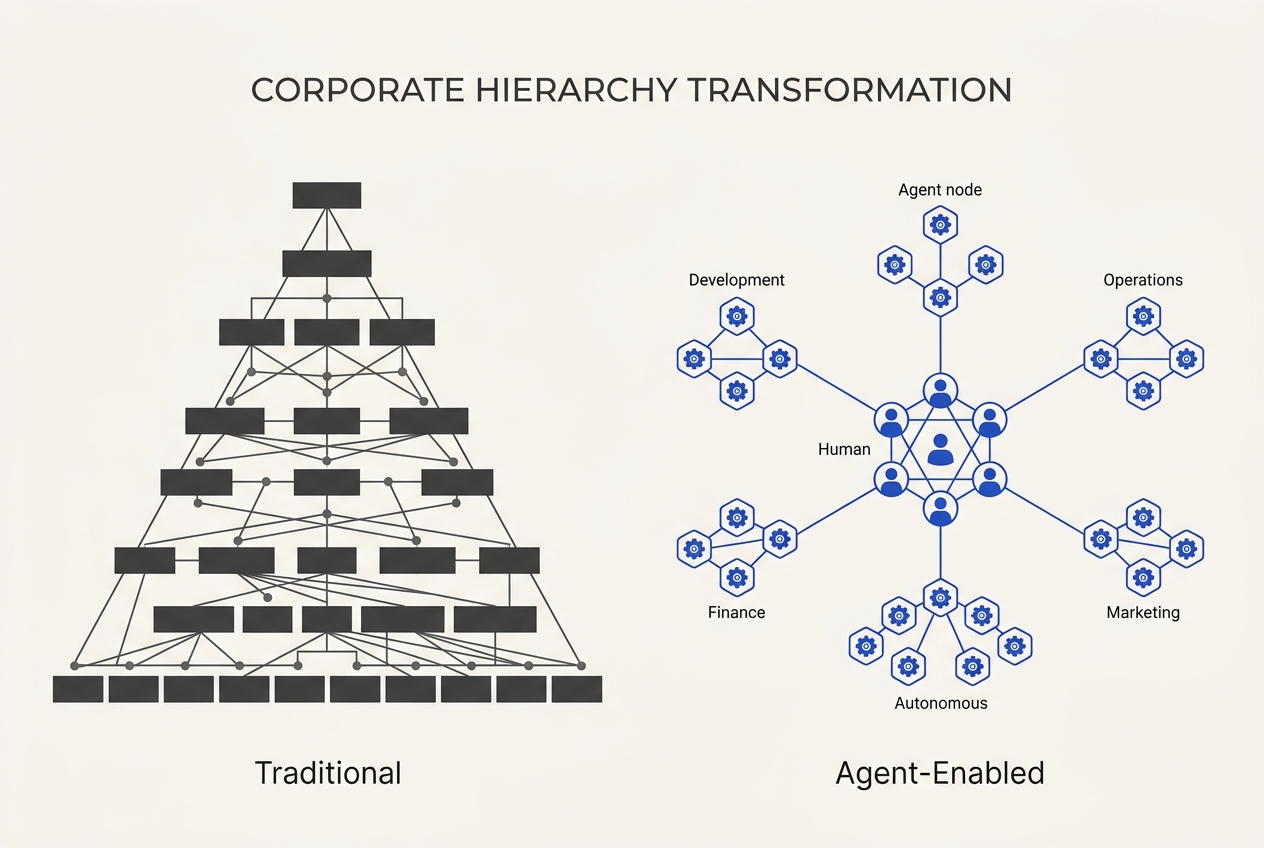
This shift alters the corporate hierarchy in three fundamental ways:
- Flattening Middle Management: Virtual employees do not require typical supervision. They log their activities automatically, reducing the need for intermediate management layers that exist primarily to coordinate tasks.
- Amplifying Individual Leverage: Human workers transition from executors of manual tasks to designers and supervisors of agentic workflows. One operator can orchestrate a fleet of dozens of virtual employees.
- Accelerating Global Operations: Autonomous agents operate continuously, allowing companies to run round-the-clock customer service, IT diagnostics, and financial analysis across time zones without regional offices.
This new reality requires a new operational model. Enterprises must view their workforce as a hybrid network of human talent and virtual employees.
A Responsible, Accountable, Consulted, and Informed (RACI) Matrix for the Hybrid Workforce
To maintain operational integrity, companies must clearly define roles. Applying a RACI matrix to human-agent teams ensures that automation does not lead to a loss of oversight.
In this hybrid framework, the division of labor must follow these rules:
- Responsible (The Agents): Virtual employees take on the role of being Responsible for executing specific workflows. This includes tasks like processing customer refunds, generating market intelligence summaries, and resolving IT system errors.
- Accountable (The Humans): Human operators remain strictly Accountable for the outcomes. Agents can act autonomously, but the ultimate business decisions, compliance, and ethical standards rest with humans.
- Consulted (Subject Matter Experts): Senior specialists are Consulted when virtual employees encounter edge cases or require strategic direction that falls outside their trained parameters.
- Informed (System Logs and Executives): Stakeholders are kept Informed through automated dashboards and logs generated by the virtual employees, ensuring total transparency of operations.
This clear division of labor protects the organization from autonomous runaways while maximizing the efficiency gains of agentic systems.
Three Phases of Agentic Transformation
Adapting to this wave requires a structured approach. Leaders can guide their organizations through the transition using a three-phase growth framework:
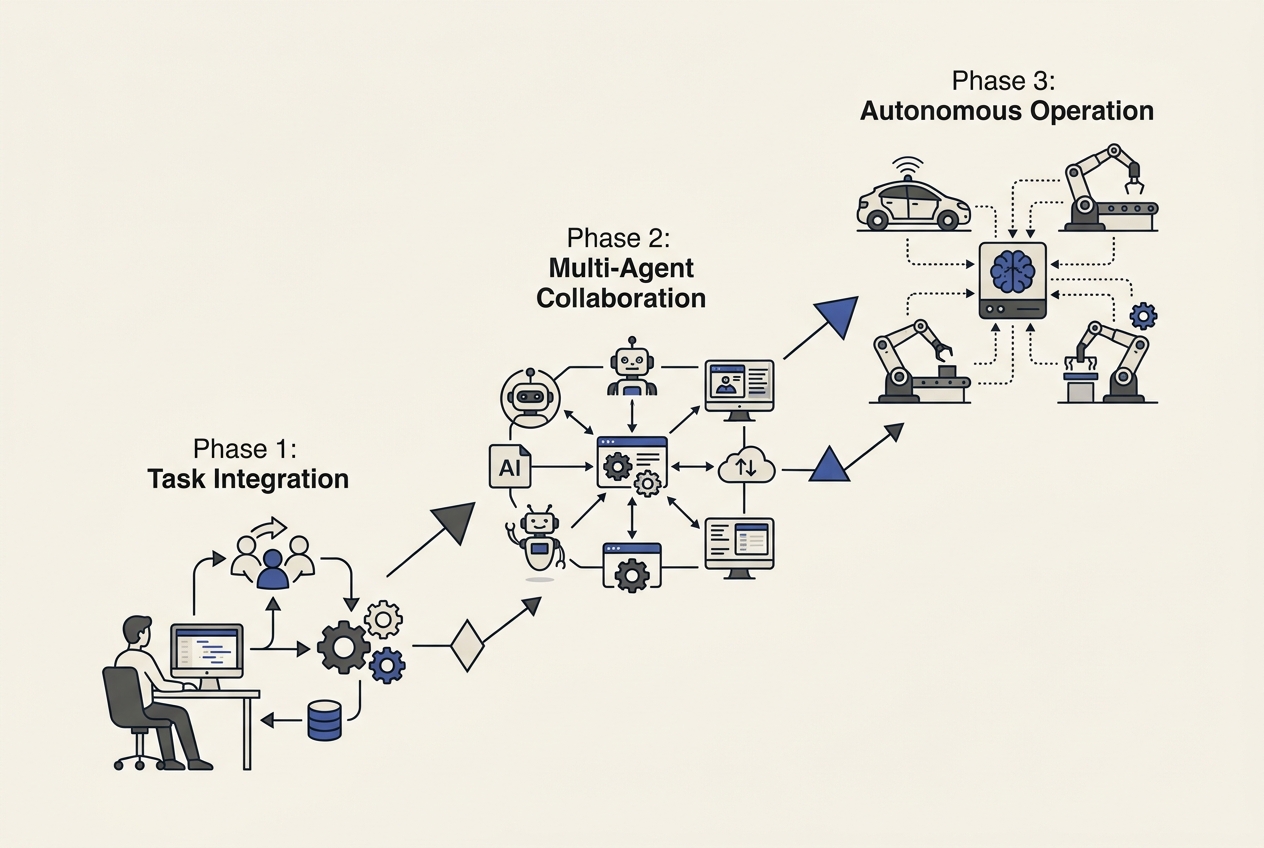
- Phase 1: Task Integration (Immediate Efficiency): Deploy task-specific agents in high-volume, standard environments such as customer support containment and data entry. Focus on reducing repetitive task hours to optimize full-time equivalent (FTE) resources.
- Phase 2: Multi-Agent Collaboration (Workflow Orchestration): Connect specialized agents to manage complex end-to-end workflows. For example, a research agent gathers data, a writing agent drafts a report, and a distribution agent sends it to clients, all collaborating autonomously.
- Phase 3: Autonomous Operation (New Business Models): Build highly leveraged business units where virtual employees run core operations, leaving humans to focus entirely on innovation, relationship management, and capital allocation.
Preparing the C-Suite for the Virtual Workforce
As virtual employees become the backbone of business execution, the metrics of leadership must change. The traditional measure of organizational strength, headcount, is no longer a valid indicator of capability.
Instead, executives must evaluate their organization based on computational leverage and workflow velocity. The future belongs to lean, highly coordinated organizations that use autonomous agents to drive global operations. The virtual employee wave is here. Leaders who proactively rebuild their operational models today will be best positioned to thrive in an increasingly automated economy.