Your AI thinks in a straight line. That is the problem.
When most people ask an artificial intelligence (AI) assistant a question, it does something simple: it thinks of one answer, step by step, in a single direction. If it makes a wrong turn at step three, every step after that is also wrong. In a 2023 study published at NeurIPS (the Conference on Neural Information Processing Systems), Princeton researchers Shunyu Yao et al. tested this "one-path" approach on a mathematical reasoning benchmark and found it solved only 4% of the puzzles correctly.
The fix? Teach AI to think the way you plan a trip.
Planning a trip across five countries
Imagine you are planning a three-week trip across five countries. You would never plan it as a single straight line: "fly to Paris, then figure out the rest later." Instead, you would sketch out three or four possible routes at the same time.
- Route A: Paris, then train to Barcelona, then fly to Rome.
- Route B: Start in Amsterdam, rent a car to Berlin, then south to Vienna.
- Route C: Begin in London, then a budget flight to Lisbon, then onward to Morocco.
You would compare them. Route B has a 14-hour drive that breaks your schedule. So you cross it out and go back to the branching point. Route C has a visa issue for the Morocco leg. You drop that branch, too. You keep Route A and explore variations within it.
This is exactly how a technique called Tree of Thoughts (ToT) works. And it is changing how AI solves hard problems.
From straight-line thinking to branching logic
To understand why ToT matters, it helps to see what came before it.
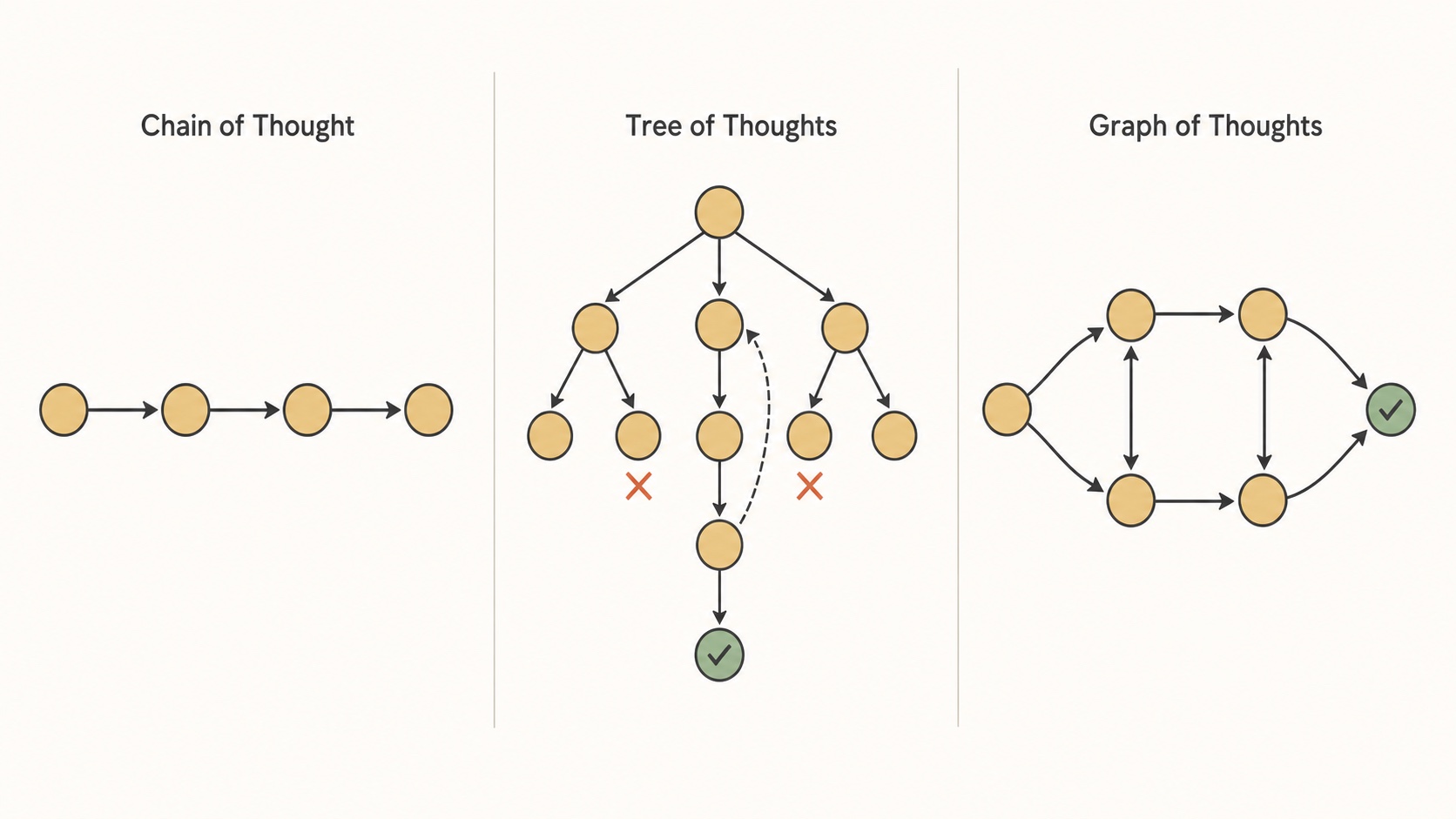
Chain of Thought (CoT) appeared in January 2022. It taught AI to "think aloud," writing out intermediate reasoning steps before giving a final answer. This was a big improvement over the old approach of jumping straight to an answer. But CoT is a single chain. One bad link ruins the whole result.
Tree of Thoughts (ToT), introduced by Shunyu Yao and colleagues at Princeton in May 2023, fixes this limitation. Instead of following one chain, the AI generates multiple "thought branches" at each step. It evaluates which branches look promising and which are dead ends. When a branch fails, the AI backtracks to an earlier point and tries a different direction, just like you would cross out the bad travel route and go back to the map.
The difference is measurable. On a mathematical puzzle called the "Game of 24" (where you combine four numbers using basic math to reach 24), CoT prompting solved the puzzle 4% of the time. ToT solved it 74% of the time using the same AI model (GPT-4), according to Yao et al.'s paper presented at NeurIPS 2023. That is roughly an 18.5x improvement in success rate, achieved by adding a structured search-and-evaluation layer on top of the model, not by making the model itself larger or more expensive to train.
Graph of Thoughts (GoT), which appeared in August 2023, takes this one step further. It lets the AI's reasoning paths reconnect and merge, forming a network instead of a tree. If two separate branches produce useful partial answers, GoT can combine them into a better solution. Think of it as two travelers exploring different neighborhoods in the same city, then meeting for dinner to share what they found.
How businesses are already using branching logic
The travel analogy is not just a metaphor for academic papers. The principle behind Tree of Thoughts (explore options, evaluate, backtrack) is showing up in how businesses configure their AI tools.
Some AI assistants now offer a "reasoning mode" where the AI generates an internal reasoning trace before responding. In these modes, the AI considers a request from multiple angles and revises its approach before giving a final response. This is separate from the full Tree of Thoughts framework (which involves explicit search algorithms), but it draws on the same insight: better results come from considering options rather than committing to the first answer.
A related development is called context engineering. Many teams now give their AI assistants a set of written rules and preferences before asking it to work on a task. These rules might cover the company's decision criteria, preferred formats, past decisions, or operating constraints. Think of it as handing a new consultant your company's operations manual on their first day. Without that context, the AI gives generic suggestions. With it, the AI's options are grounded in your actual business reality.
The combination of branching reasoning and pre-loaded business context means the AI can explore multiple directions *while already knowing your company's constraints*. That changes the output from generic suggestions to recommendations shaped by your situation.
Human-in-the-loop: the best routes need a local guide
There is a gap between "the AI can consider multiple options" and "the AI picks the right option for your situation." Branching logic helps the AI avoid dead ends, but the AI still does not know which branch your business actually prefers.
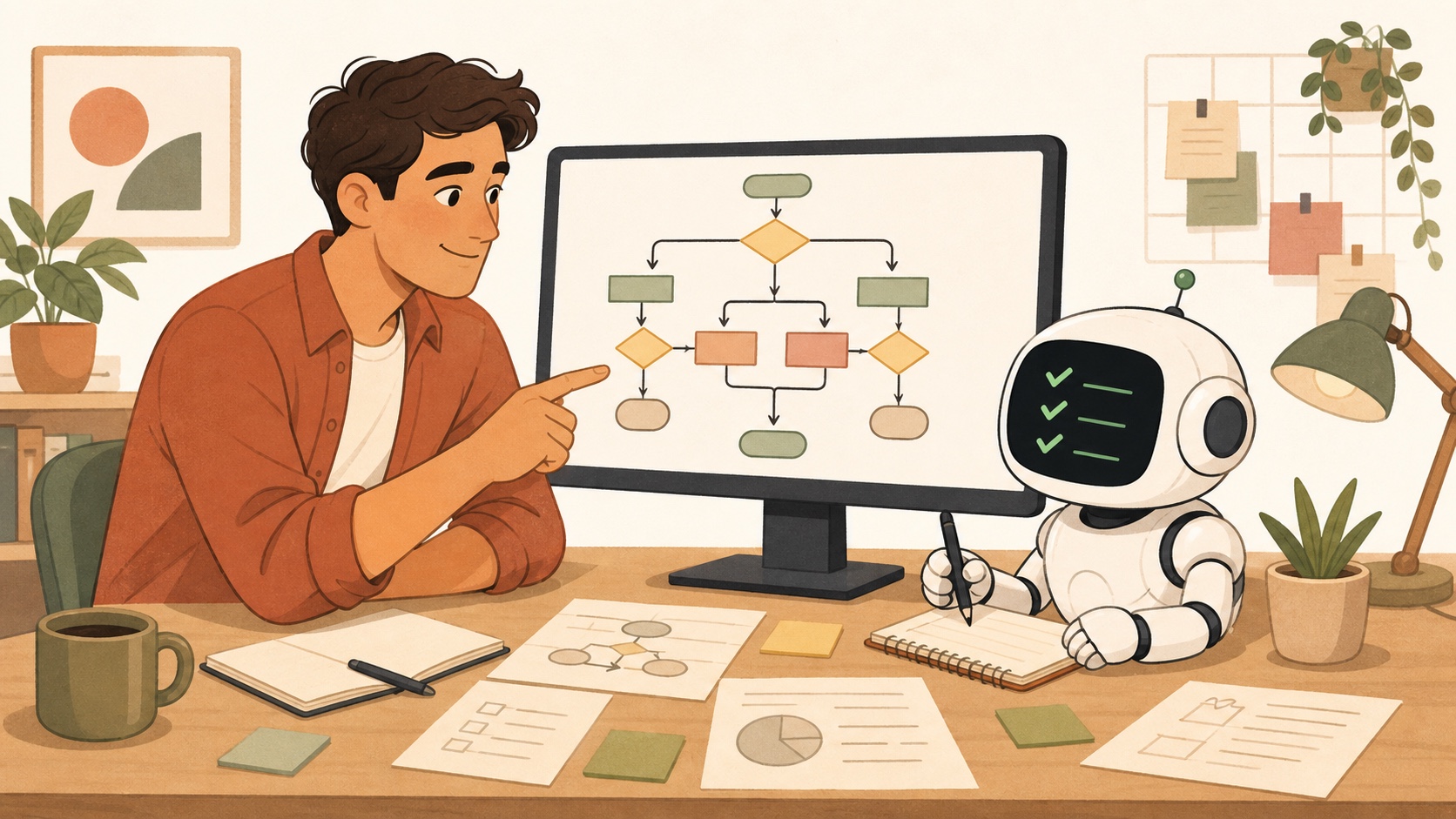
This is where human-in-the-loop (HITL) design closes the gap. One example is a technique called a "structured AI interview." Instead of asking the AI to produce a finished plan, you first ask it to challenge your assumptions. The AI becomes an interviewer rather than a helper. It asks pointed questions about your plan: What are the constraints? What happens if this part fails? What have you not considered?
The AI walks down each branch of the decision tree with you, resolving unclear points one by one. By the time you are done, you and the AI share the same mental model of the problem. The AI did not decide for you. It helped you think through the decision more thoroughly, more quickly, and with fewer gaps.
This is the same principle behind good trip planning. The best travel plans are not made by a guidebook alone or by a local friend alone. They come from combining the guidebook's broad knowledge with the local friend's specific context. HITL design makes AI a structured thinking partner rather than an answer machine.
Why this is critical for companies right now
Most companies train their staff to use AI as a faster search engine: "ask it a question, get an answer." That captures only a fraction of the value. The real leverage comes when employees learn to think *with* AI using structured decision-making patterns like Tree of Thoughts.
Consider a marketing team planning a product launch. Without structured AI thinking, they ask the AI: "Write me a launch plan." They get one generic plan. With Tree of Thoughts reasoning, the AI generates three launch strategies simultaneously, evaluates each against the company's budget and timeline, identifies that Strategy B has a regulatory conflict, backtracks, and presents Strategies A and C with trade-off analysis. With a structured AI interview, the team lead then stress-tests both remaining strategies through a question-and-answer (Q&A) session before committing.
The result is a more thorough decision process. Trade-offs are mapped before the team commits, rather than discovered after launch.
Deloitte's 2026 Global Human Capital Trends report emphasizes the growing importance of training employees to work effectively with AI and improving organizational decision-making. The direction is clear: the goal for companies is to move beyond basic AI adoption and build teams that use structured reasoning with AI as a regular part of how they make decisions.
A practical starting point
You do not need a research lab to start using Tree of Thoughts principles. Here is a simple framework anyone can try today:
- Ask for options, not answers. Instead of "What should I do?", prompt the AI with "Give me three possible approaches to this problem, with the trade-offs for each."
- Ask the AI to evaluate its own ideas. Follow up with "Which of these three approaches is weakest, and why?" This mirrors the self-evaluation step that makes ToT effective in research settings.
- Add your context. Tell the AI your constraints, your past decisions, and your preferences. The more context it has, the better it can prune bad branches.
- Use a structured challenge step. Before committing to a direction, ask the AI (or a colleague) to poke holes in the plan. This is the HITL principle in action.
This four-step pattern, "branch, evaluate, contextualize, challenge," mirrors what the research shows is most effective. And it works whether you are planning a product launch, designing a training program, or, yes, planning a trip across five countries.
The bottom line
AI is learning to think the way experienced decision-makers already think: consider multiple options, evaluate each one honestly, backtrack when something does not work, and refine the plan based on real constraints.
Tree of Thoughts is not magic. It is structured decision-making, encoded into AI. The organizations that teach their people to think alongside AI in this way will build teams that make better decisions with less wasted effort.
The tools exist today. The research is published. The patterns are learnable. What remains is for companies to move from asking AI for answers to thinking with AI through options.