Most AI Tools Give You a Fast Gut Reaction. That Is a Problem.
Imagine your most trusted analyst has read every report ever published, attended every industry conference, and can answer any question in seconds. Sounds perfect. Now imagine that same analyst never pauses to check their own logic. They answer from instinct, confident and fast, every single time.
That describes how earlier generative Artificial Intelligence (AI) chatbots worked. And for many business teams still using those tools today, it explains why outputs look polished but sometimes miss the point.
Here is what changed, and why it matters for your team.
How the Human Brain Decides
Psychologist Daniel Kahneman spent decades studying how people make decisions. His research, summarized in the book *Thinking, Fast and Slow*, identified two distinct modes that the brain uses:
Mode 1: Fast, automatic, and associative. This mode fires instantly. It pattern-matches based on past experience. It is efficient and works well for familiar situations. It is also the source of most cognitive shortcuts and errors when situations are new or complex.
Mode 2: Slow, deliberate, and analytical. This mode kicks in when the stakes are high or the problem is unclear. It checks assumptions, considers alternatives, and works through a problem step by step before committing to an answer.
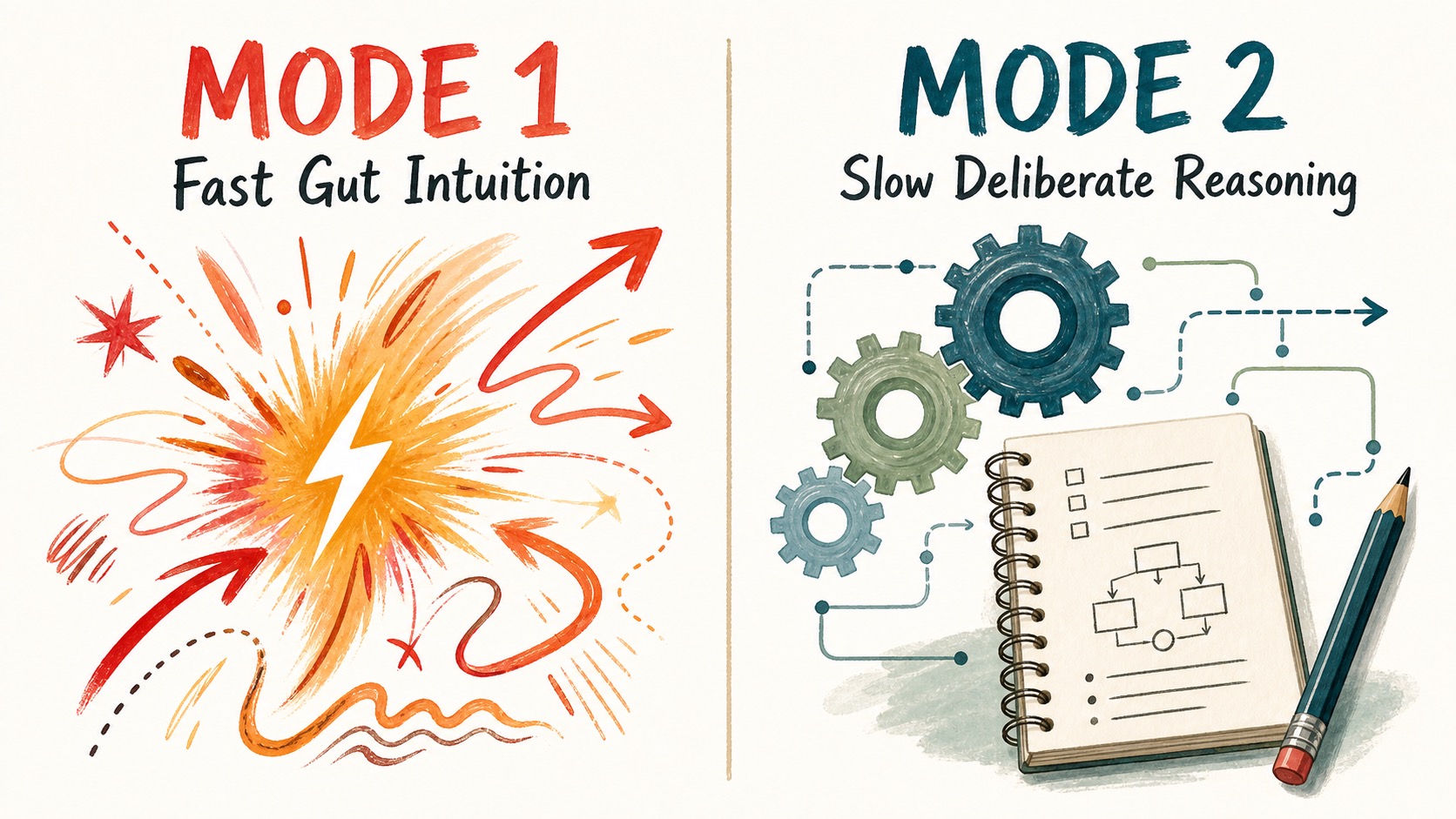
Psychological research demonstrates that humans rely heavily on Mode 1 for rapid everyday processing, reserving deliberate Mode 2 thinking for situations that explicitly demand conscious effort. Because Mode 2 is mentally expensive, the brain avoids it whenever possible, even when the situation clearly requires structured analysis.
Standard AI: An Extremely Fast Mode 1
Earlier generative AI chatbots follow a pattern similar to Mode 1. They are trained to predict the next best word given the words before it. This makes them lightning fast and remarkably fluent. They can draft emails, summarize documents, and generate ideas almost instantly.
However, standard generative AI tools do not perform deliberate, multi-step verification by default unless specifically configured to do so. They complete language patterns efficiently, but they do not automatically pause mid-answer to interrogate their own assumptions.
This is why standard chatbots can state an inaccurate answer with the same confidence as a correct one. They complete patterns rather than checking logic.
For low-stakes tasks, fast pattern-matching is fine. For decisions involving contracts, strategy, risk, or investment, it is not enough.
The New Generation: AI That Thinks Before It Speaks
Reasoning models represent an evolution in how AI systems process queries. Tools such as OpenAI's o1 and o3 series, or Google's Gemini Thinking, are designed to take more time working through complex questions before responding. They evaluate problems thoroughly: testing assumptions, catching contradictions, and refining conclusions before delivering a final output.
Think of it this way. A standard AI is given a complex question and immediately writes an answer on the whiteboard. A reasoning model is given the same question, pulls out a scratchpad, works through the logic in steps, crosses out bad assumptions, and only then writes the final answer.
The impact on output quality is real, but it comes with an important boundary. A benchmark study by researchers at Harvard Business School and Boston Consulting Group identified what they called the "jagged technological frontier." For tasks within AI's capability boundary (such as creative ideation and product concept drafting), workers using AI completed tasks significantly faster with higher quality. However, for tasks outside that boundary, uncritical trust in AI output led to errors. Reasoning models expand this boundary, but human oversight remains essential to spot when a problem crosses the frontier.
The 5 Levels of AI: A Strategic Map
In 2024, tech reporting highlighted an internal, illustrative framework shared within OpenAI describing five conceptual levels of AI capability evolution:
Level 1: Conversational AI. Standard chatbots and voice assistants. They respond fluently to questions and can draft content, but they wait for each instruction before acting.
Level 2: Reasoners. AI that can analyze complex problems step by step. Reasoning models like o1, o3, or Gemini Thinking are often discussed under this category because they evaluate trade-offs, check logic, and provide structured recommendations.
Level 3: Agents. AI that not only thinks but acts. An agent receives a goal and plans its own sequence of steps to achieve it, without needing a prompt for every action. It adapts when something does not work.
Level 4: Innovators. AI that generates genuinely novel ideas. Not recombinations of existing content, but new hypotheses, strategies, or designs that have not appeared before.
Level 5: Organizations. AI that operates as an entire functional unit, from goal-setting to execution, across all departments.
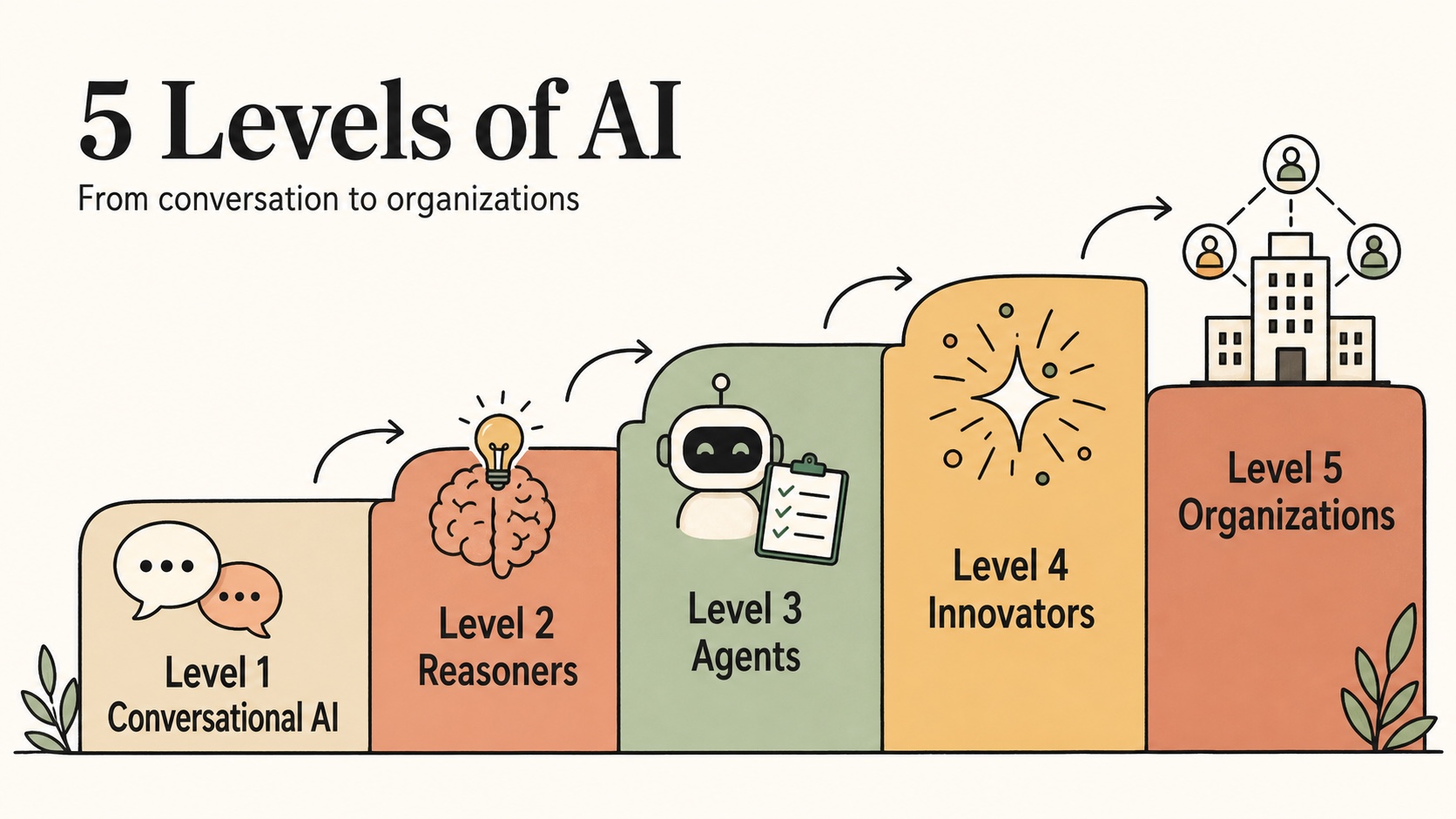
Most enterprise teams today operate somewhere between Level 1 and the early edge of Level 2. The jump from Level 1 to Level 2 is not just a technology upgrade. It requires a change in how teams think about AI's role.
Why Understanding Reasoning Changes How You Use AI
Here is the practical implication that most teams miss: if you use a reasoning model exactly like a standard chatbot, you lose most of its value.
A reasoning model earns its edge on tasks that require multi-step logic. Strategic analysis. Regulatory review. Financial modeling. Scenario planning. Vendor risk assessment. These are the domains where "answer fast" is the wrong objective.
Deploying a reasoning model on a task like "summarize this email" is like hiring a senior consultant to do data entry. Technically possible. Wasteful in practice.
The real value appears when you treat the reasoning model as a thinking partner. You give it a complex problem, a set of constraints, and relevant data. You let it work through the logic. Then you review the final output, cited sources, and supporting evidence where provided, rather than blindly accepting the conclusion.
Enterprise adoption surveys indicate that while most organizations have experimented with AI in at least one business function, connecting AI deployment directly to measurable financial returns requires deliberate operational design. The gap is not technology. It is application logic.
What This Means for Corporate Efficiency and Team Structure
The arrival of reasoning-capable AI raises a question that executives are beginning to take seriously: which decisions still require a human, and which can now be delegated?
This is not about replacing people. It is about redistributing cognitive load.
Consider a typical approval workflow in a mid-size company. A manager reviews 12 vendor bids. The review involves reading proposals, checking contract terms, comparing pricing models, and flagging risk clauses. This work requires careful, multi-step analysis. It takes time. Errors occur because attention drops after the third or fourth document.
When paired with defined evaluation criteria and structured inputs, a reasoning model can process multiple bids systematically, flag contradictions, rank options, and draft an initial recommendation. When combined with human verification, this creates a faster and more consistent evaluation workflow. The manager's role shifts from manual data extraction to strategic judgment and stakeholder communication.
Operational feedback indicates that knowledge workers using reasoning-capable AI spend less time handling repetitive analysis, shifting their focus toward higher-complexity strategic tasks. The work did not disappear. It moved up the value chain.
This shift also has implications for team structure. When reasoning-quality AI handles the analytical layer of decisions, organizations can revisit how many analytical roles they need at each level. The question is not "how do we reduce headcount" but "what kind of thinking do we now need more of, and where should we invest?"
Strategic judgment, ethical review, relationship management, and cross-functional communication are all areas where human capability remains essential and where AI cannot yet substitute. These are also the areas where most senior talent wants to spend its time.
How to Apply This Now
Before deploying any AI reasoning tool in a team workflow, three questions help identify where the value is real:
1. Does this decision require checking its own assumptions?
If yes, a reasoning model adds genuine value. If the task is routine and the answer space is narrow, a standard tool is sufficient.
2. Is the cost of a wrong decision significant?
Reasoning models trade speed for accuracy. For high-stakes decisions (compliance, strategy, contracts), that trade is worth making. For low-stakes tasks (formatting, routing, summarizing), speed matters more.
3. Can the final output and evidence be verified?
Make sure your team reviews the final output, cited sources, and supporting evidence where provided, rather than accepting the output automatically. This human-in-the-loop verification is where quality control is maintained.
The Bridge Between AI Levels Is Reasoning
We are at a transition point. Standard AI gave teams a powerful Mode 1 capability. Reasoning models add Mode 2. The combination, used correctly, means that AI can now participate not just in producing content but in thinking through decisions.
The illustrative five-level framework matters because it sets expectations accurately. Level 3 agents, which can plan and execute independently, are only useful to organizations that have already learned how to supervise Level 2 reasoning. Teams that skip this step and deploy autonomous agents without understanding how reasoning works will face the same problem as teams that ignored data quality before deploying standard AI: poor inputs, confident-sounding errors, and eroding trust in the technology.
The organizations building the strongest AI capability are not necessarily the ones with the newest tools. They are the ones who redesigned their decision workflows first.
[END_BLOG_POST_DRAFT]