The advisor who never lifts a finger
While many organizations are pushing forward with AI adoption, surveys show that only 12% of CEOs report seeing both cost reduction and revenue growth from their AI investments. The gap is not about intelligence. Most AI tools today are already smart enough. The gap is about action.
For the past three years, business leaders have treated AI as a conversation partner. You type a question, you get an answer, and then you go do the work yourself. Copy the answer. Paste it somewhere. Open another tool. Fill in the fields. That model reached its ceiling a while ago, and most people felt it before they could name it. The next wave of AI does not just advise. It acts. It books flights, sends emails, fills forms, files reports, and keeps running multi-step workflows while you sleep.
Some researchers call this shift the move toward Large Action Models (LAMs) or "agentic AI." Agentic AI systems combine reasoning language models (LLMs) with tool execution and workflow control to complete end-to-end tasks. The terminology is still evolving, but the underlying concept is identical. Where a standalone LLM is a brilliant advisor who has read every book in the library, an agentic system is the operations manager who walks into the office, opens the laptop, and gets the job done.
What an LLM actually does
A Large Language Model is trained on enormous amounts of text. It reads, summarizes, translates, drafts, and reasons. Ask it to write a project brief, compare two business strategies, or explain a regulation, and it performs well. Sometimes brilliantly.
But a standalone model stops at the edge of the screen. Unless integrated with tool execution environments, an LLM outputs text rather than action. It does not click buttons, navigate software, fill out purchase orders, or touch the tools your team uses every day. Ask a standalone LLM to "book a flight to Tokyo for next Tuesday" and it will write you a polished paragraph explaining how to book a flight. It will not open your travel portal, select the itinerary, enter your passport details, and confirm the reservation.
That limitation pushed every company into the same loop: ask AI for advice, then assign a human to execute it. For a quick question, fine. For a ten-step operation that crosses three different systems, it creates a bottleneck that no amount of smarter text generation will fix.
What action models and agents change
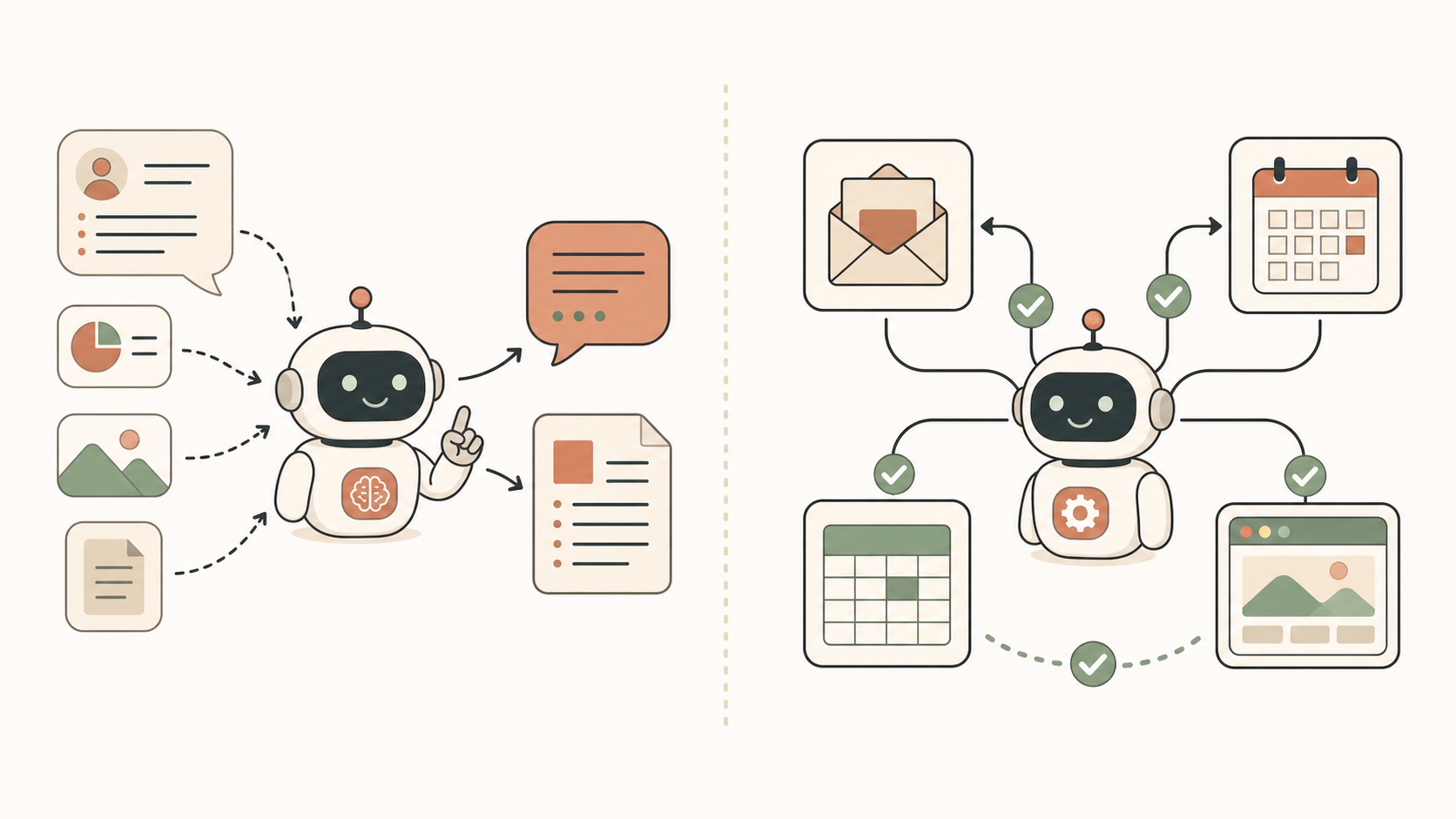
Action-oriented models and agentic systems are trained not just on language but on action sequences, APIs, and user interfaces. They learn how software works and how to chain steps into a completed task. Where an LLM outputs a paragraph, an agentic system outputs a finished job.
In practice, this means the AI can operate your business tools the way a junior colleague would. Log into the project management system, create a task, assign it, set the deadline, send the notification. Open your email, read an invoice, pull the line items, enter them into accounting software, flag anything that looks wrong. Navigate a government compliance portal, download the form, fill in the fields from company records, save the completed document.
Reliability is the hard part, and it is still a work in progress. Early agent prototypes in 2024 and 2025 broke constantly on long task sequences. A 90% success rate per step sounds reasonable until you multiply it across ten steps. That gives you a 35% chance of the whole workflow completing without error. The latest systems in 2026 have made real progress through specialized training on actual application interfaces, structured verification at each step, and human-in-the-loop checkpoints for anything sensitive. Multi-step failures still happen, but the distance between "impressive demo" and "tool I can rely on at work" has shrunk.
The real landscape in 2026
This is not theoretical. The largest technology companies shipped action-capable AI products this year, and the open-source community kept pace.
ChatGPT Work launched in July 2026. It runs a virtual computer environment in the background: browsing websites, filling out forms, executing code, pulling context from Google Drive, Notion, and Gmail. Hand it a large goal and it breaks the goal into subtasks, works through them over hours if needed, and delivers finished documents, spreadsheets, or reports. Enterprise editions add audit trails and human approval checkpoints.
Gemini Spark, announced at Google I/O 2026, runs as a background agent integrated with Google Workspace. Operating in Google's cloud infrastructure, it triages email, coordinates calendars, organizes documents, and chains multi-step tasks without locking up your local computer. It asks for explicit confirmation before executing critical operations.
Manus demonstrated the concept early and loudly. Built by a Singapore-based startup, it went viral in 2025 as one of the first agents that could take a single high-level goal and autonomously plan, research, write, and deliver the finished output. Meta acquired the company for $2 billion in late 2025. Chinese regulators ordered the deal unwound in April 2026, and the platform is now being sunsetted. The technology proved the model works. The regulatory fallout proved something else: agentic AI now carries geopolitical weight that plain chatbots never did.
On the open-source side, OpenClaw lets organizations run an AI agent runtime on their own hardware. It handles messaging, browser automation, file management, and scheduling. When you configure it with local models, data stays on your own servers. When you connect it to external model providers, data flows to those services, so the actual privacy guarantee depends entirely on how you set it up. Hermes, released by Nous Research in early 2026 and now one of the most-starred AI agent repositories on GitHub, adds a self-improving learning loop. Every time it finishes a task, it evaluates its own performance and saves a reusable skill template. Over weeks and months, a Hermes agent gets measurably better at the specific workflows your team runs.
Why "just chatting" hit its ceiling
The conversation-only model of AI had three structural problems that better models alone could not fix.
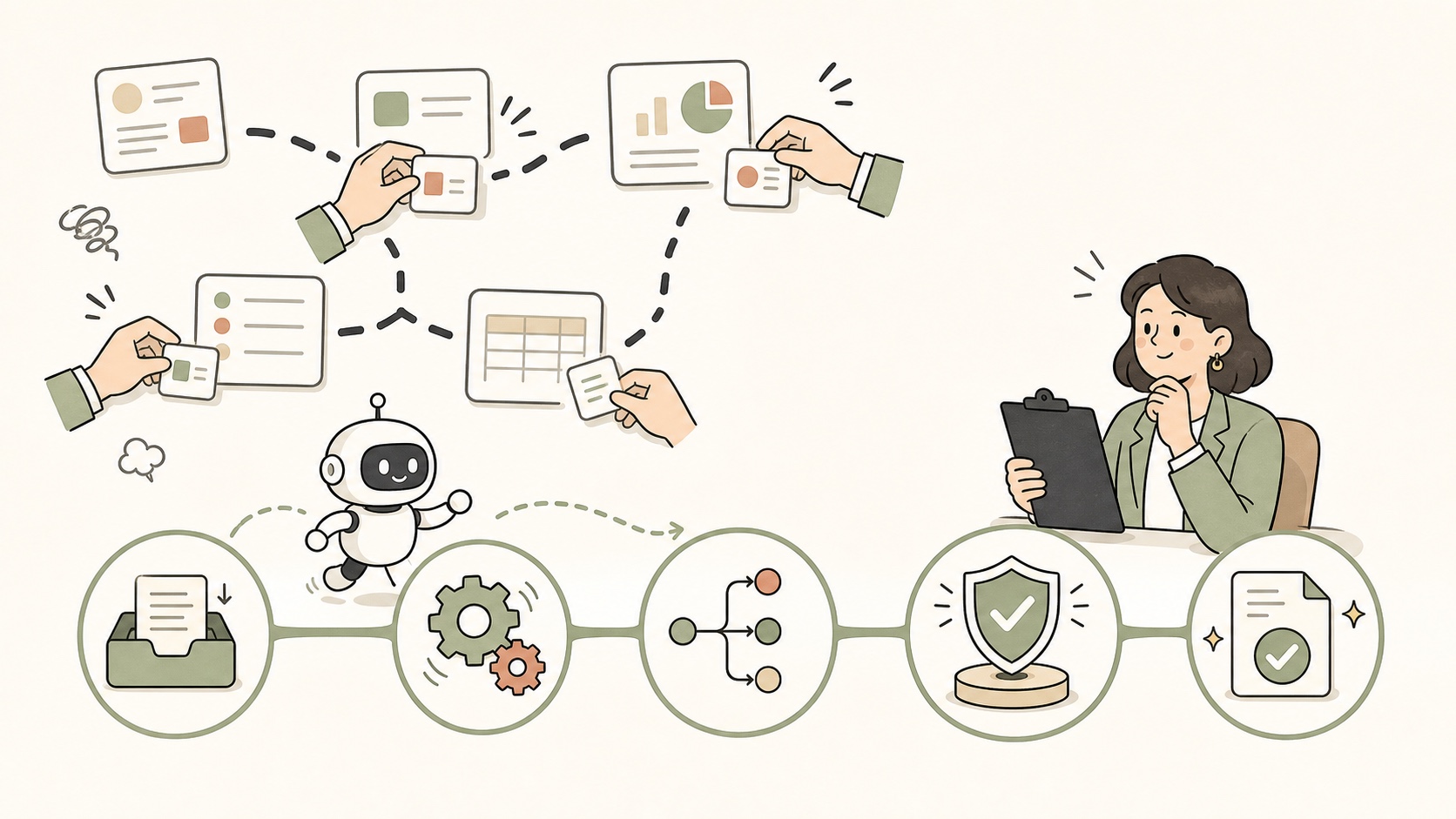
The first was the copy-paste tax. Every useful AI output required a human to move it into the right system by hand. Draft an email reply, then copy it into the email client. Generate a financial summary, then paste it into the slide deck. Propose a project timeline, then rebuild it manually in the project management tool. Each transfer took time, introduced errors, and erased the efficiency that AI was supposed to create.
The second was context loss. Once you left the chat window and started doing the work yourself, the AI lost track of what happened next. It never learned whether its advice worked, whether the email landed, whether the report got filed correctly. Without that feedback, it could never improve based on real outcomes.
The third was task fragmentation. Most business operations are not single questions with single answers. They are workflows, sequences of steps that cross multiple tools, require decisions along the way, and produce outputs that feed into the next process. A conversation-only AI handles the first step and walks away. An action-capable AI handles the full sequence.
What this means for companies
Gartner projects that 33% of enterprise software applications will embed agentic AI capabilities by 2028. Early adopters who have deployed agents in production report measurable efficiency gains, though industry-wide ROI data for agentic AI specifically is still emerging.
The numbers also carry a warning. Gartner expects more than 40% of agentic AI projects to be canceled by 2027, driven by three recurring problems: escalating costs, unclear business value, and inadequate risk controls. The pattern is consistent: companies deploy AI agents without redesigning their workflows first, and they end up automating a broken process. Faster broken results are still broken results.
The companies that get this right start with different questions. Which ten-step workflows consume the most human hours? Where does work stall because someone has to copy data from one system to another? Which approval processes could run faster if a reliable agent gathered the information, filled the forms, and routed them for sign-off?
This is a strategy and process design problem, not a technology problem. The skill that matters most for the next few years is not "how to talk to AI." It is "how to design workflows and set organizational strategy so that AI agents can execute reliably."
Where ARUO helps
ARUO works with organizations making this transition. We do not sell a chatbot or a single product. We work with leadership teams to find the high-value action workflows hiding in daily operations, design the agent architecture that connects existing systems, and build the governance layer that keeps humans in control of sensitive decisions.
The shift from conversation to action is the biggest change in how businesses use AI since the chatbot appeared. Companies that redesign their workflows and train their teams for this model will operate at a different speed. The rest will keep copying and pasting, and they will wonder why AI never quite delivered on the promise.