The 17 percent reality: Why traditional Business-to-Business (B2B) workflows are stalling
According to research from Gartner, enterprise buyers spend only 17 percent of their total purchasing journey meeting with potential suppliers, spending the rest of their time researching independently and aligning internal teams. When buyers evaluate multiple vendors, any single sales representative receives only 5 to 6 percent of that customer's total time. Furthermore, 61 percent of B2B buyers state that they prefer a representative-free purchasing experience, according to Gartner survey data.
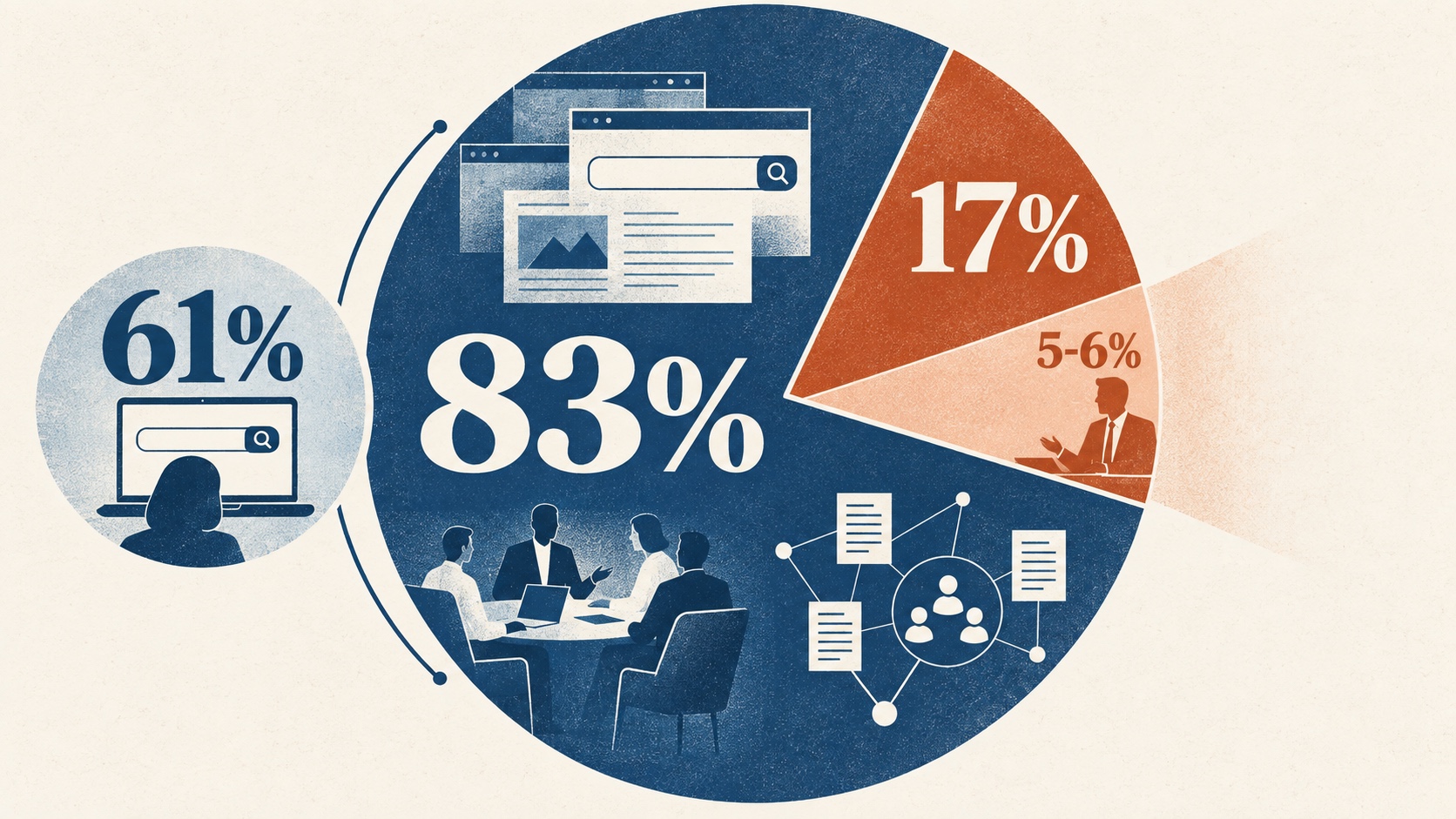
Despite this clear shift toward independent evaluation, most large industrial corporations remain organized around 20th-century department silos. Product engineers generate static technical documentation. Field sales representatives field initial inquiries. Application specialists spend days answering repetitive specification questions. Purchasing managers route orders through disjointed dealer networks.
This structure creates friction at the exact moment when customer momentum is highest. An aerospace design engineer trying to identify a structural bonding adhesive cannot wait three business days for an introductory sales call and another week for a technical data sheet. When answers are slow, modern buyers do not wait. They switch to a competitor whose specifications are immediately accessible.
The core challenge facing enterprise leaders is not a lack of machine intelligence. It is an outdated operating model that traps proprietary knowledge behind bureaucratic handoffs.
The 3M case: Turning materials expertise into an autonomous engine
To understand how global corporations must adapt, consider 3M's deployment of agentic systems in 2026.
On December 29, 2025, 3M announced that it would debut "Ask 3M" alongside an expanded version of its Digital Materials Hub at the Consumer Electronics Show (CES) 2026. Built on Amazon Web Services (AWS) infrastructure using Amazon Bedrock and AgentCore, Ask 3M is an external, customer-facing digital assistant piloted to help engineers solve complex bonding-design challenges using tapes and adhesives.
The system addresses a concrete engineering problem. A design engineer tasked with bonding carbon fiber to aluminum under extreme vibration and temperature cycles faces hundreds of potential adhesive formulations. Combing through dense manuals or waiting for an application consultant slows down product development cycles.
Under 3M's design, the system aims to operate through an agentic workflow rather than simple keyword search:
- It clarifies physical constraints, including substrate materials, cure times, and environmental exposures, through conversational dialogue.
- It evaluates product suitability across 3M adhesives and tapes to recommend relevant options.
- Alongside the expanded Digital Materials Hub, which offers simulation-ready data cards, 3M aims to help engineers validate material performance virtually before cutting physical prototypes.
- It supports small-quantity purchase options to help engineers test materials during initial prototyping.
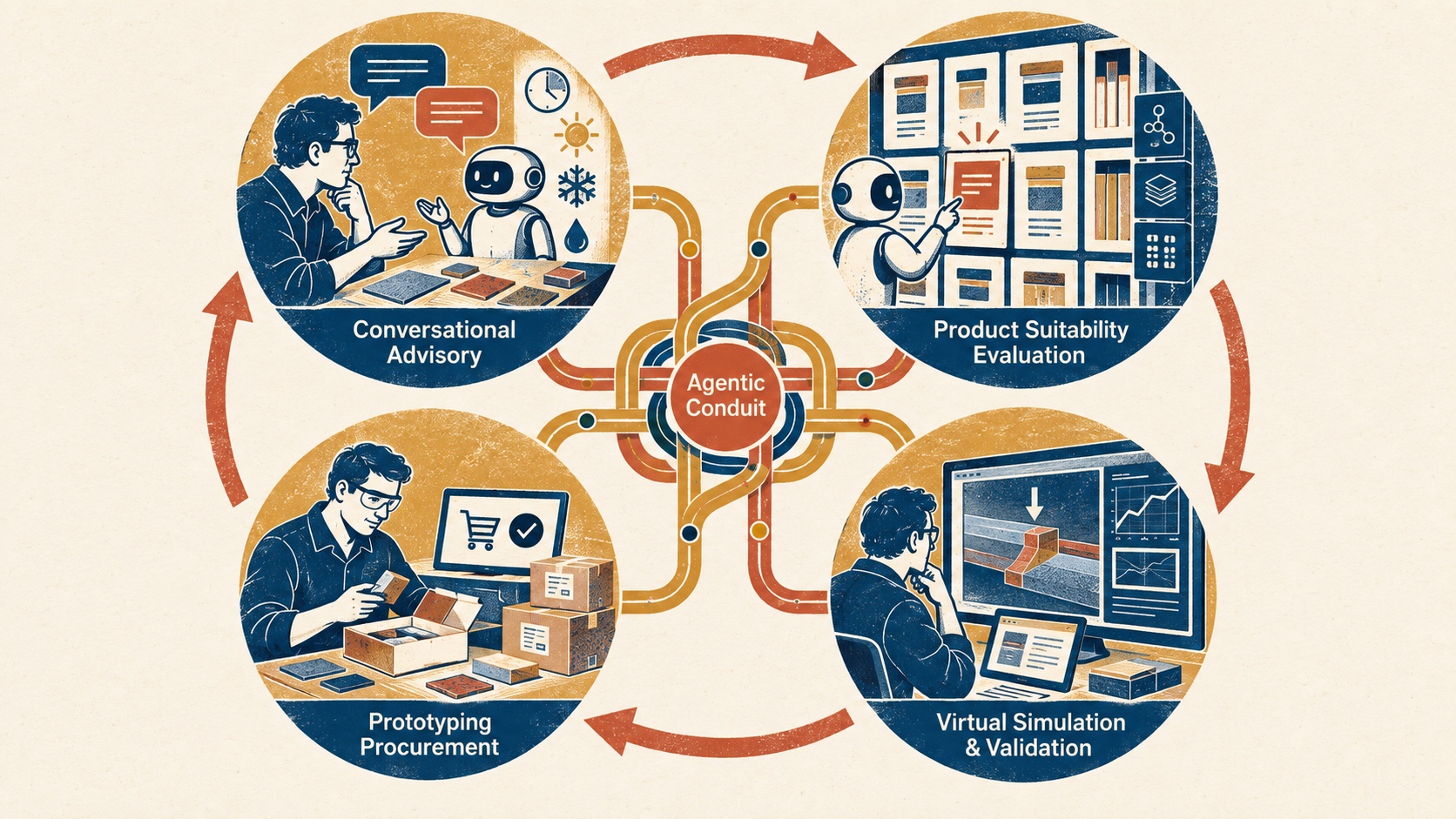
This architecture reflects a deliberate shift in digital strategy. Rather than treating AI as a basic customer support chatbot, 3M designed these digital platforms to bridge technical advisory, virtual validation, and procurement into a connected customer journey. The goal is to replace slow, manual coordination across engineering, technical service, and sales with a unified digital interface.
The pilot trap: Why cosmetic AI add-ons fail to deliver value
The natural reaction of many corporate leadership teams is to purchase Artificial Intelligence (AI) software for each existing department. Marketing teams acquire generative copywriting software. Customer service departments install basic question-answering bots. Software engineers adopt code completion tools.
This piecemeal approach rarely changes business performance. McKinsey research on enterprise agentic systems in 2025 emphasizes that capturing economic value from autonomous workflows requires leaders to redesign fundamental operating models, warning that layering agents onto existing departmental structures creates coordination bottlenecks.
The reason is simple: speeding up individual tasks inside isolated silos does not fix broken handoffs between silos.
If an AI agent can recommend an optimal industrial coating in ten seconds, but sending a physical sample requires two weeks of inter-departmental approvals and manual inventory checks, customer velocity remains zero. The bottleneck simply migrates from technical research to corporate process.
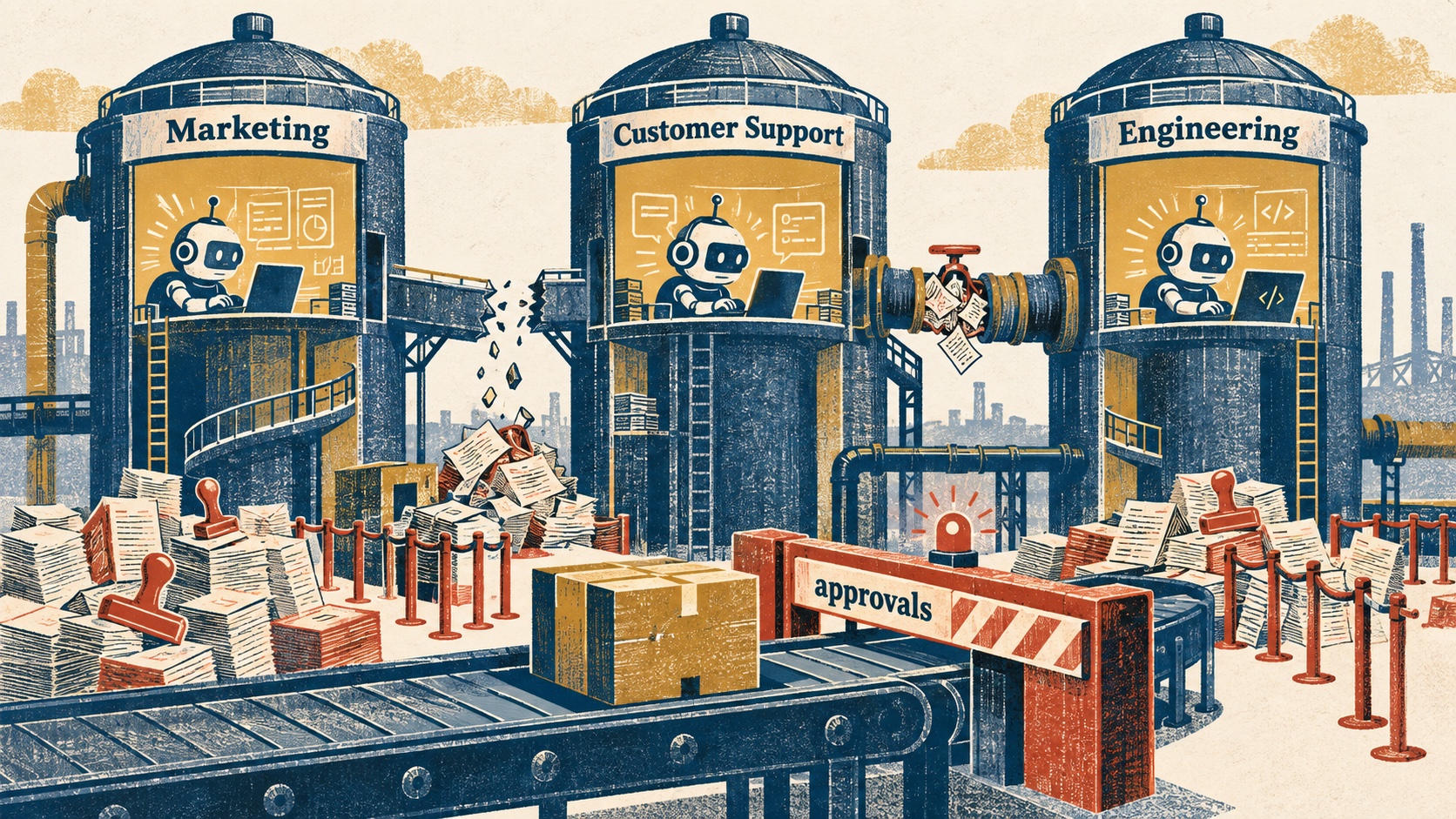
When systems operate without structural redesign, errors and administrative overhead multiply. Companies invest heavily in software subscriptions while their underlying business agility remains unchanged.
Three structural shifts required for the agentic enterprise
Moving from isolated tools to autonomous enterprise workflows requires structural reorganization. Organizations that succeed with agentic systems redesign their operations around three fundamental shifts.
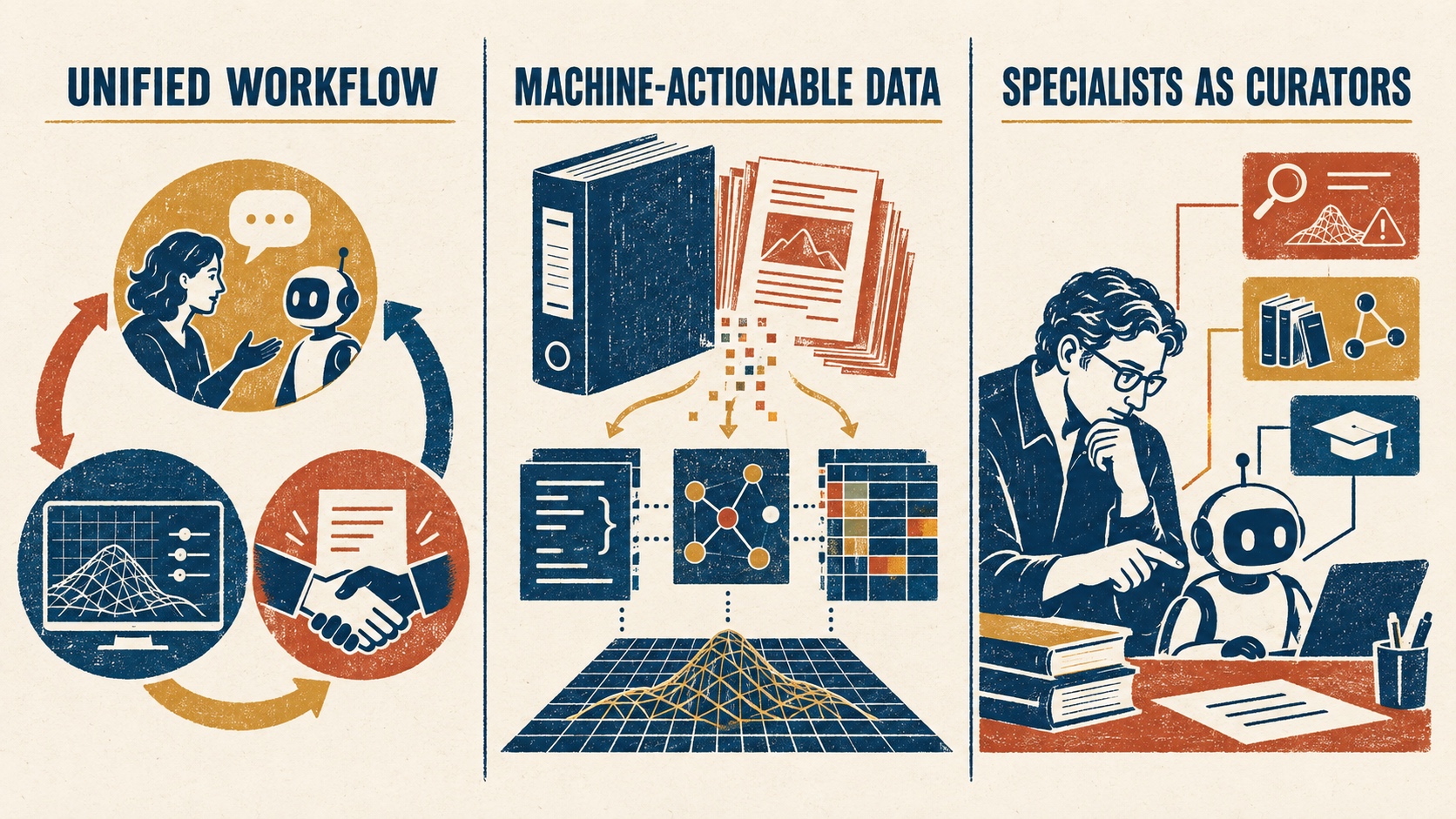
Unify technical advisory, simulation, and commercial transactions
Traditional organizational charts separate product creation from customer consulting and transaction processing. Research and Development (R&D) creates the product, technical sales explains it, and field distribution handles fulfillment.
Agentic systems aim to collapse these distinct phases into a single workflow. As reflected in 3M's rollout of digital advisory and materials modeling tools, technical evaluation, virtual simulation, and procurement are designed to function as an interconnected loop.
To support this model, companies must merge cross-functional teams around customer problem journeys rather than department functions. Application engineers, digital product managers, and supply chain liaisons must share ownership of the agent's end-to-end customer resolution rate.
Transform static documentation into machine-actionable data
Large enterprises possess decades of proprietary intellectual property. However, most of this knowledge sits locked inside static Portable Document Format (PDF) files, internal wikis, and unstructured document repositories.
Public model knowledge alone is insufficient for reliable, high-stakes proprietary technical guidance. An error in an aerospace adhesive specification can cause structural failure.
Enterprises must treat their technical knowledge base as core product infrastructure. This requires:
- Digitizing technical specifications into structured, version-controlled databases.
- Creating simulation-ready data formats that external engineering software can ingest directly.
- Establishing formal data verification pipelines so agents only cite verified corporate testing data.
According to 3M, the company maintains 49 core technology platforms. By organizing technical documentation and material testing records into structured digital formats, enterprises can give AI systems the foundation needed to operate with domain accuracy.
Shift human specialists from repetitive triage to knowledge curation
A frequent concern among domain specialists is that autonomous agents will replace human technical experts. In practice, the opposite occurs. The nature of expert work changes.
In a conventional organization, senior application engineers spend a large share of their working hours answering repetitive questions about product compatibility, temperature tolerances, and standard certifications. This is an inefficient use of scarce technical talent.
In an agentic operating model:
- AI agents handle routine inquiries, standard constraint matching, and document delivery.
- Human experts serve as Knowledge Curators and Exception Handlers under a Human-in-the-Loop framework.
- Specialists focus on novel edge cases, bespoke engineering challenges, and next-generation product design.
- Every time a human specialist solves an unprecedented customer problem, that verified solution is ingested into the knowledge base, expanding the agent's capabilities for future interactions.
This shift elevates domain experts from administrative gatekeepers to mentors of the organization's autonomous knowledge systems.
Governance and decision rights: Defining agent autonomy
An organization cannot deploy autonomous agents without establishing explicit governance rules. The central operational question is no longer "what can the model do?", but "what is the agent authorized to decide?"
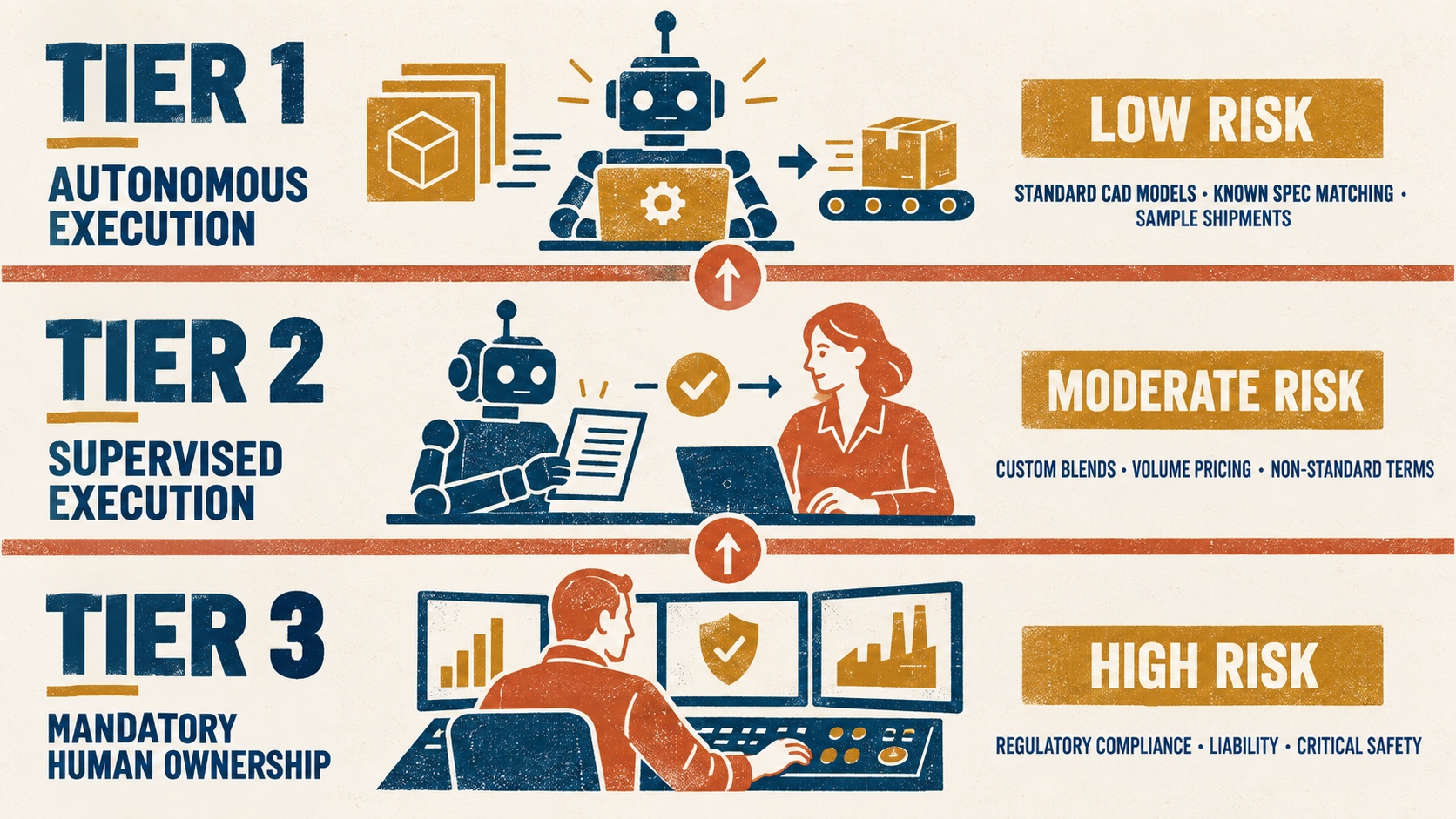
Enterprises must establish tiered decision thresholds:
- Autonomous execution: The agent acts independently on low-risk, high-frequency requests. Examples include distributing standard Computer-Aided Design (CAD) models, matching known material specifications, and approving low-cost sample shipments.
- Supervised execution: The agent prepares recommendations for human approval. Examples include custom material blends, high-volume pricing discounts, and non-standard warranty terms.
- Mandatory human ownership: The agent immediately routes queries to senior personnel. Examples include contractual liability disputes, regulatory compliance filings, and safety-critical failure investigations.
Hardcoding these boundaries into system architecture allows organizations to scale customer interactions rapidly while controlling legal, financial, and operational risk.
The executive imperative: Reorganize before you automate
The lesson of 3M's agentic deployment extends far beyond the chemical and manufacturing industries.
As buyers increasingly demand self-directed, instant technical answers, organizations that hide their expertise behind manual corporate procedures will lose market share. Installing disconnected chatbots on top of 20th-century department structures only automates existing inefficiency.
Real competitive advantage comes from restructuring the operating model. Leaders must dismantle department walls, turn dormant intellectual property into structured digital assets, and reassign top talent to high-value oversight and innovation.
Companies that undertake this structural transformation will turn their accumulated expertise into an autonomous, scalable commercial engine. Those that delay will find their human sales teams waiting for phone calls that never arrive.
References
- Gartner, "The B2B Buying Journey," Gartner Sales Insights. https://www.gartner.com/en/sales/insights/b2b-buying-journey
- Gartner, "Future of Sales 2025," Gartner Research. https://www.gartner.com/en/sales/insights/future-of-sales
- 3M, "3M to debut AI-powered assistant Ask 3M and expanded 3M Digital Materials Hub at CES 2026," 3M News Center, December 29, 2025. https://news.3m.com/2025-12-29-3M-to-debut-AI-powered-assistant-Ask-3M-and-expanded-3M-Digital-Materials-Hub-at-CES-2026
- 3M, "Science Applied to Life: Core Technology Platforms," 3M Corporate. https://www.3m.com/3M/en_US/company-us/about-3m/technologies/
- McKinsey & Company, "The agentic organization: Contours of the next paradigm for the AI era," 2025. https://www.mckinsey.com/capabilities/people-and-organizational-performance/our-insights/the-agentic-organization-contours-of-the-next-paradigm-for-the-ai-era
- TechOrange, "3M Agentic AI," September 16, 2026. https://techorange.com/2026/09/16/3m-agentic-ai/