The skill that matters most is not coding
According to McKinsey's State of AI research, 88% of organizations now use AI in at least one business function. Yet only about one-third have begun to scale their AI programs at the enterprise level. The rest remain stuck in pilot mode. A recurring barrier, cited across multiple industry reports, is not a shortage of engineering talent. It is a lack of operating discipline: teams that struggle to define clear requirements, measurable outcomes, or structured workflows before they begin.
The bottleneck is not technology. It is human expression. Your ability to break down a goal, state constraints, and define what "done" looks like has quietly become the single highest-leverage skill in a modern workplace. And that skill requires zero technical background.
Forget "prompts," think "operational briefings"
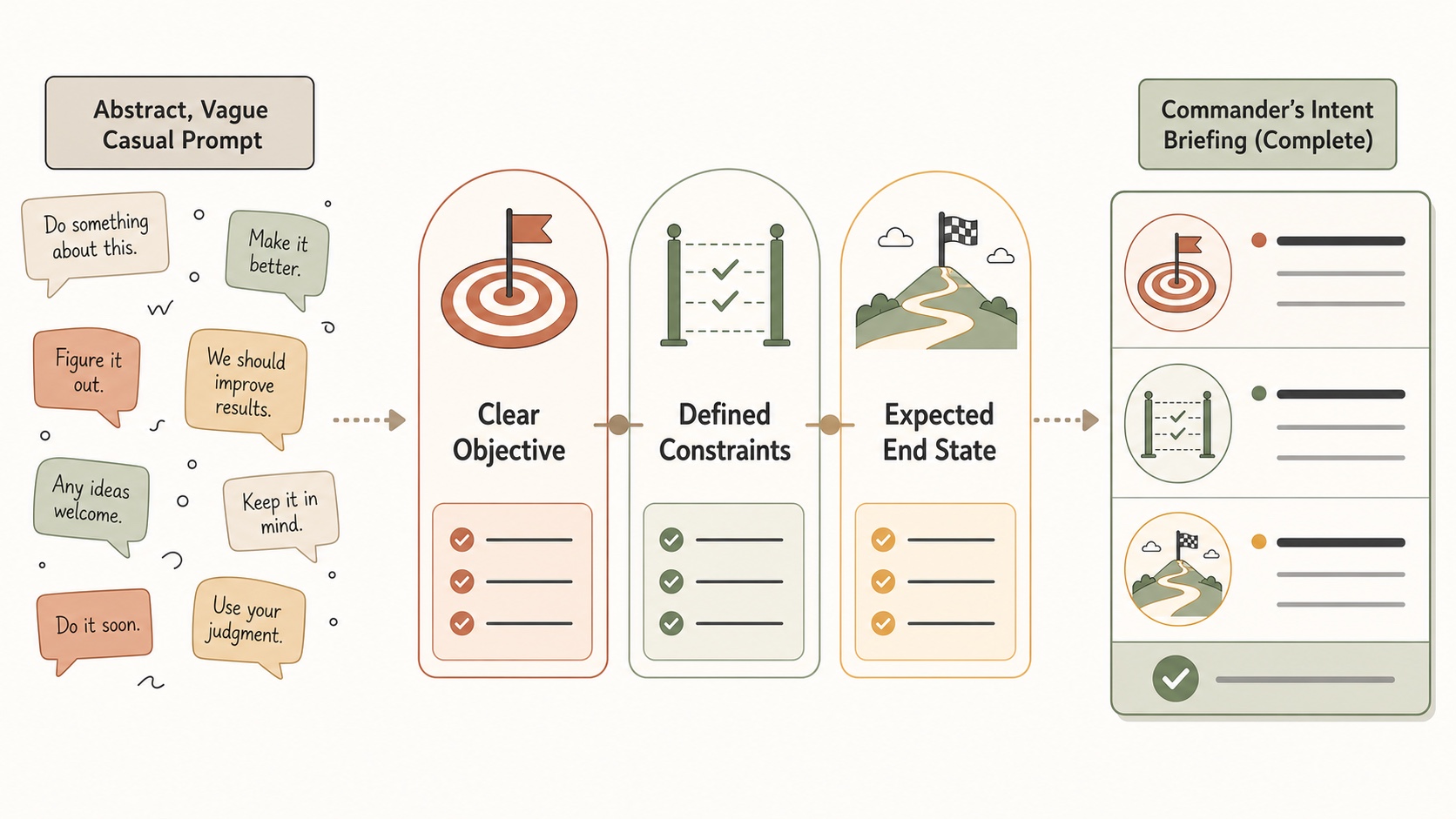
The word "prompt" carries baggage. It suggests a single magic sentence typed into a chatbox, a trick phrase that unlocks the right answer. Early guides to AI were full of this thinking: add "step by step," say "you are an expert," append "think carefully." These tricks worked sometimes. They failed unpredictably.
The industry has moved past this. In 2026, the strongest AI users increasingly rely not on single-sentence prompts but on structured briefings. The difference is structural: a prompt is a question you toss over the wall, while a briefing is a mission package you hand to a capable operator.
Military organizations solved this problem decades ago with a concept called Commander's Intent. When a general sends a unit into the field, the order does not say "walk north for three kilometers, turn left, set up position behind the second hill." That level of micro-instruction breaks the moment conditions change. Instead, the order states three things:
- The objective (what the mission must accomplish)
- The constraints (what the unit must not do, and what resources it has)
- The end state (what success looks like when the mission is finished)
Everything else is left to the unit's judgment. If the road is blocked, the unit finds another route. If the weather changes, the unit adapts. The intent stays the same even when the plan falls apart. And this maps cleanly to how effective AI instruction works, because AI, like a field unit, operates best when it understands the purpose behind the task rather than a rigid script of steps.
What a Commander's Intent briefing looks like for AI
Say you want your AI assistant to prepare a competitive analysis report. A typical "prompt" approach sounds like this: "Write me a competitive analysis of Company X." The result will be vague, surface-level, and full of generic statements pulled from the model's training data. You will spend more time editing than you saved.
A Commander's Intent approach sounds like this:
"Your objective is to produce a competitive analysis comparing Company X and Company Y in the Japanese enterprise SaaS market. Focus on three dimensions: pricing model, integration ecosystem, and customer retention rate. Use only publicly verifiable data from the past 12 months. The output format is a structured memo of no more than 1,500 words, with a one-paragraph executive summary at the top. Do not include speculative projections. Flag any data points you cannot verify."
Same task, completely different result. The second version works because it provides what every good subordinate needs: a clear mission, defined boundaries, and an explicit picture of what the finished product should look like.
Why natural language became the new operating language
For forty years, the interface between humans and computers was rigid technical syntax. If you wanted a machine to do something, you had to adapt to its strict rules and formal commands.
Large Language Models (LLMs) reversed this relationship. The machine now speaks your language. You can express intent in plain English (or Japanese, or Mandarin), and the machine interprets it. This is a genuine shift in how work gets done, not just a marketing headline.
But the shift created a trap. Because you can talk to AI casually, many people assumed that casual input would produce professional output. It does not. Natural language is flexible, ambiguous, and context-dependent. The same sentence can mean different things depending on who says it and when.
The solution is not to learn technical syntax. It is to bring structure to your natural language. Think of it as the difference between chatting with a friend and briefing a new hire on their first day. Both use the same words. Only one of them consistently produces the result you need.
The three layers of a good AI briefing
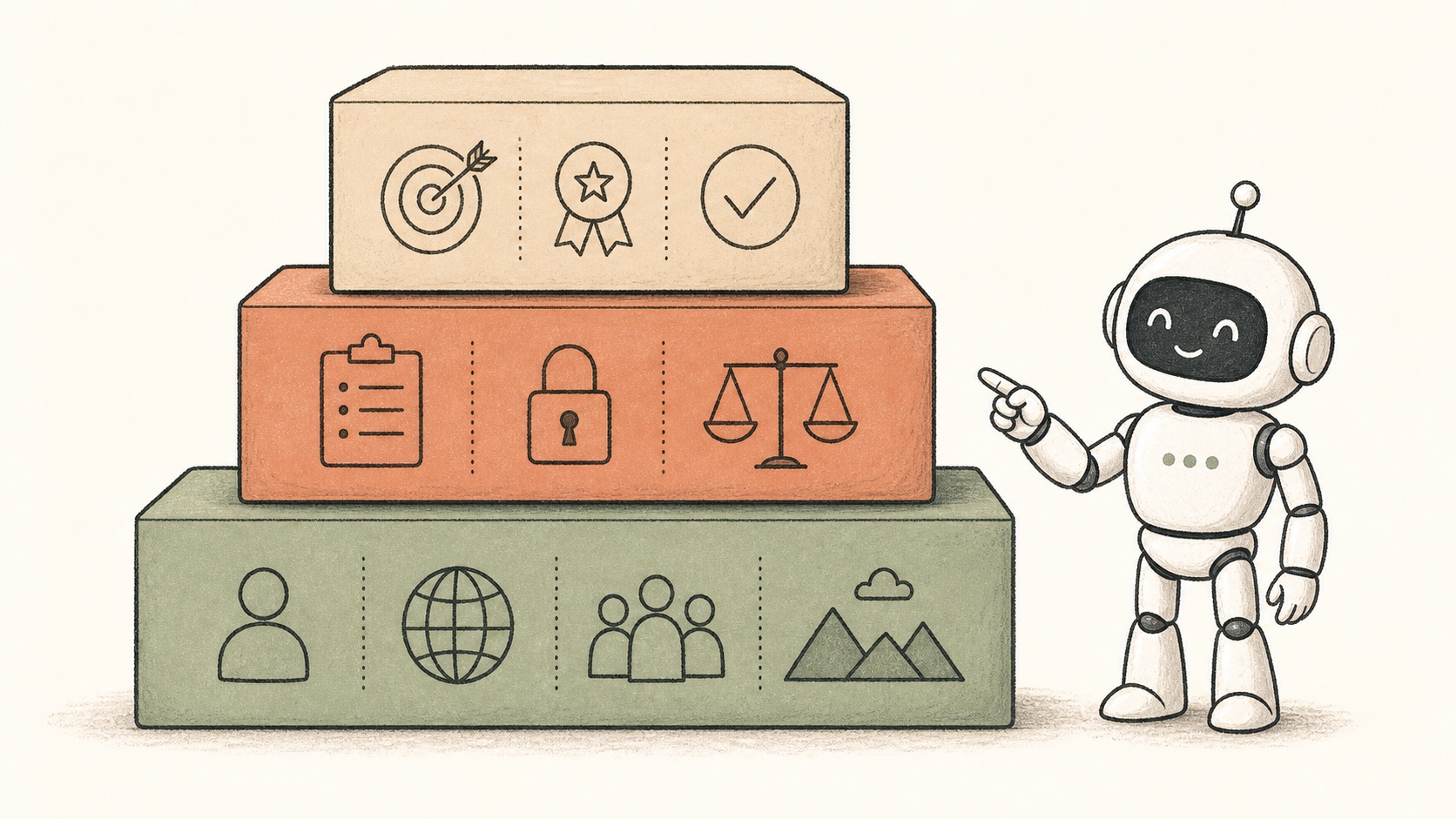
Every effective AI instruction contains three layers, whether you write it in one paragraph or across a full page.
The first layer is context and role. Tell the AI what situation it is operating in and what perspective to adopt. "You are reviewing a legal contract for a mid-size Japanese manufacturer" gives the model a reference frame that shapes every decision it makes downstream. Without context, the model guesses, and those guesses compound through the entire output.
The second layer is the task itself, along with its constraints. State what the AI should do, what it should not do, and what format the output should take. Constraints are where most people fail. An instruction without constraints is like a budget without line items. Everything seems possible until the results come back wrong.
The third layer is success criteria. Describe what a good result looks like. "The output should be clear enough for a non-technical board member to act on without follow-up questions" is a success criterion. It gives the AI a target to calibrate against.
This structure is not new. Military leaders, project managers, and film directors have communicated complex intent this way for a long time. AI just made it the universal work language.
Logical expression beats coding in the AI era

Here is the claim that makes some engineers uncomfortable: in 2026, clear logical thinking is more valuable than the ability to write code.
This does not mean coding is useless. It means that coding was always a proxy for a deeper skill: the ability to decompose a complex problem into sequential, unambiguous steps. That decomposition skill is exactly what effective AI instruction requires.
A person who can clearly articulate "first validate the input format, then cross-reference against the existing database, then flag any records where the timestamp falls outside the fiscal quarter, then produce a summary grouped by department" is giving the AI something it can execute reliably. That person may have never written a line of technical script. Meanwhile, a person who writes "analyze this data and give me insights" will get generic output regardless of their technical background. The AI did not fail in that scenario. The instruction did.
The shift is real and measurable across every field. In modern workplace workflows, professionals increasingly act as editors and directors rather than manual authors. They spend less time producing raw material from scratch and more time verifying, directing, and structuring the work that AI produces. The core competency is no longer mechanical typing. It is structured communication.
What this means for your team
If you lead a team, this has immediate practical implications.
First, invest in communication training alongside technical training. The ability to write a clear brief, define acceptance criteria, and articulate constraints is now a production skill, not a soft skill.
Second, create shared templates for AI instructions. Just as your company has templates for project briefs and meeting agendas, build templates for common AI tasks. This reduces variance and makes results reproducible across the team.
Third, evaluate AI readiness by expression quality, not tool familiarity. The team member who writes the clearest SOPs (Standard Operating Procedures) is often the one who will get the best results from AI, regardless of their technical background.
Fourth, treat AI like a capable new hire, not a search engine. A new employee needs onboarding, context, clear expectations, and guardrails. Give your AI the same. The people who treat AI as a conversation partner rather than a query box consistently outperform those who do not.
The real literacy of the AI age
The twentieth century rewarded people who could write code. The twenty-first century rewards people who can write intent.
Writing a clear Commander's Intent briefing requires rigorous thinking. You must know your objective deeply enough to state it in one sentence, understand your constraints well enough to list them explicitly, and picture the end state clearly enough to describe it to someone who has never seen it before.
That is hard work. It is also the most transferable skill you will ever develop. It works with every AI model, every platform, every language, and every industry. When the tools change (and they will), the ability to express what you want with precision and structure will remain.
The question is not whether you can code. The question is whether you can command.