Corporate leaders frequently misdiagnose why enterprise artificial intelligence (AI) initiatives struggle to move beyond proof of concept. The constraint is rarely algorithmic horsepower. Rather, it is a structural failure of management: attempting to turn specialized professionals into generic prompt operators, instead of using human taste and domain expertise to direct AI execution.
The experience of Shiseido Japan offers an instructive case study. When the cosmetics group deployed about 130 AI ambassadors across about 40 business departments, employee active usage of Google Gemini reached over 80%. Yet as Business Insider Japan reported in August 2026 following the Google Cloud Next Tokyo conference, this widespread adoption soon encountered an operational wall.
Grassroots usage had expanded, but deeper business impact remained constrained. Requests for sales analysis and campaign performance metrics flooded the central data team. Without structured business context and unified data definitions, raw chat prompts could not satisfy the analytical demands of complex enterprise operations.
Shiseido's challenge reflects a common corporate blind spot. Distributing open-ended AI chat interfaces and tracking employee logins as a blunt Key Performance Indicator (KPI) produces little operational progress. Without workflow redesign and domain alignment, organizations simply burn application programming interface (API) tokens to generate mountains of digital noise.
The fallacy of the synthetic generalist

Generative AI offers remarkable versatility across coding, text generation, visual synthesis, and data querying. Yet modern enterprises depend on the division of labour. Expecting every employee to become an all-purpose AI generalist contradicts the basic economics of corporate organization.
Asking an experienced software engineer to create promotional graphics for Social Networking Services (SNS) using an AI image generator illustrates the problem. The engineer can produce a high-resolution image in seconds, but lacks the visual hierarchy, typographic judgment, and brand intuition required for consumer marketing. The output is technically functional, yet commercially sterile.
The reverse expectation is equally flawed. Demanding that retail beauty advisors or field sales representatives write multi-step prompt engineering sequences to conduct statistical Point of Sale (POS) data analysis misallocates expensive human capital.
Effective commercial analysis requires two distinct capabilities:
- Hypothesis definition: Formulating the specific commercial questions, market variables, and business assumptions that matter.
- Validation and error detection: Identifying hallucinations, auditing logical leaps, and recognizing biased or incomplete source data.
A professional who lacks marketing taste will generate tone-deaf promotional materials. A team member without statistical training will accept plausible AI hallucinations as factual market insights. Technology multiplies existing competence, but cannot manufacture missing domain expertise.
Generation is abundant, but human taste remains scarce
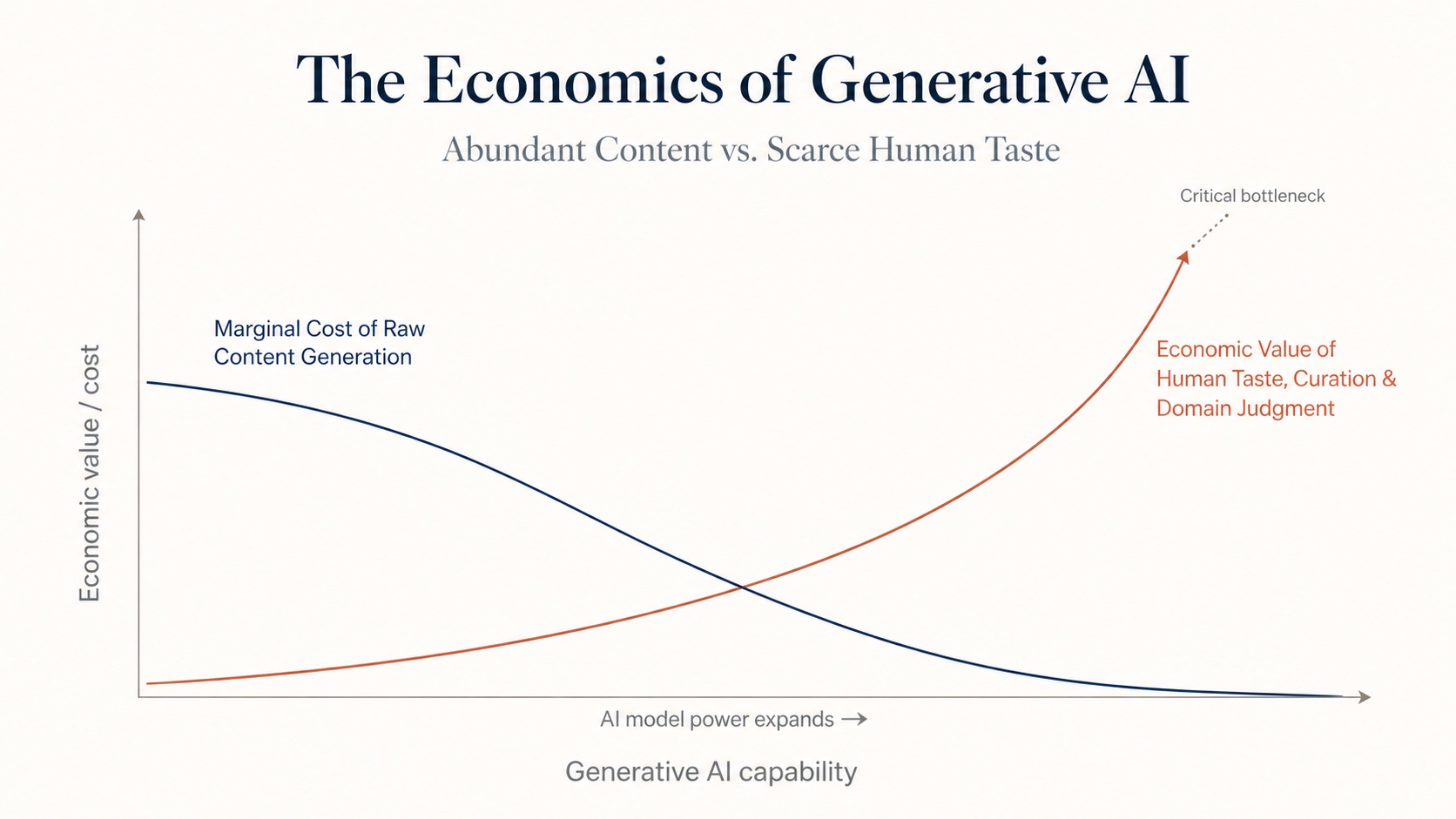
Generative AI substantially lowers the cost of producing text, images, and preliminary charts. In economic terms, when the marginal cost of producing raw content falls toward zero, the standalone commercial value of that content collapses.
Value migrates entirely to the scarce complement: human taste, domain discernment, and institutional judgment. Deciding whether a synthetic visual respects brand heritage, or whether a commercial deduction in an automated report is credible, requires human judgment built through years of sector experience.
When organizations encourage unguided AI usage without clear evaluation standards, employees flood internal channels with digital clutter: unverified draft reports, generic customer copy, and superficial data summaries. This unvetted volume creates severe operational drag. Managers and senior teams spend hours reviewing, fact-checking, and rewriting low-quality synthetic outputs, consuming time and budget while increasing internal friction.
The Shiseido pivot: packaging capability to liberate human judgment
Shiseido addressed this operational bottleneck by changing how it delivered data and AI capabilities to its business units.
The cosmetics company had previously managed digital initiatives through Shiseido Interactive Beauty (SIB), a joint venture founded with Accenture in 2021. In late 2025, Shiseido concluded the partnership, acquired full ownership in January 2026, and absorbed the entity on June 1, 2026. This reorganization shifted digital functions and specialist talent directly into Shiseido and Shiseido Japan, with transformation initiatives led by the Digital Transformation (DX) and AI Transformation (AIX) Strategy Department under Tatsuya Nagemori.
When high Gemini adoption overwhelmed the central data team led by Takahiro Lee, the group moved away from functioning as a reactive helpdesk. Instead, they adopted a Data as a Product (DaaP) model.
Under this approach, the central team organizes data with defined business context, standardized metrics, and unified governance. They built a dedicated data agent for the sales division on Google Gemini Enterprise. Sales representatives managing major drugstore accounts can query sales data in natural language, enabling staff to test commercial hypotheses during client negotiations without waiting days for manual data pulls.
By packaging data complexity into intuitive tools, Shiseido allowed frontline professionals to focus on their core strengths: retail relationships, brand positioning, and commercial negotiation.
Structuring the enterprise: taste first, AI execution second
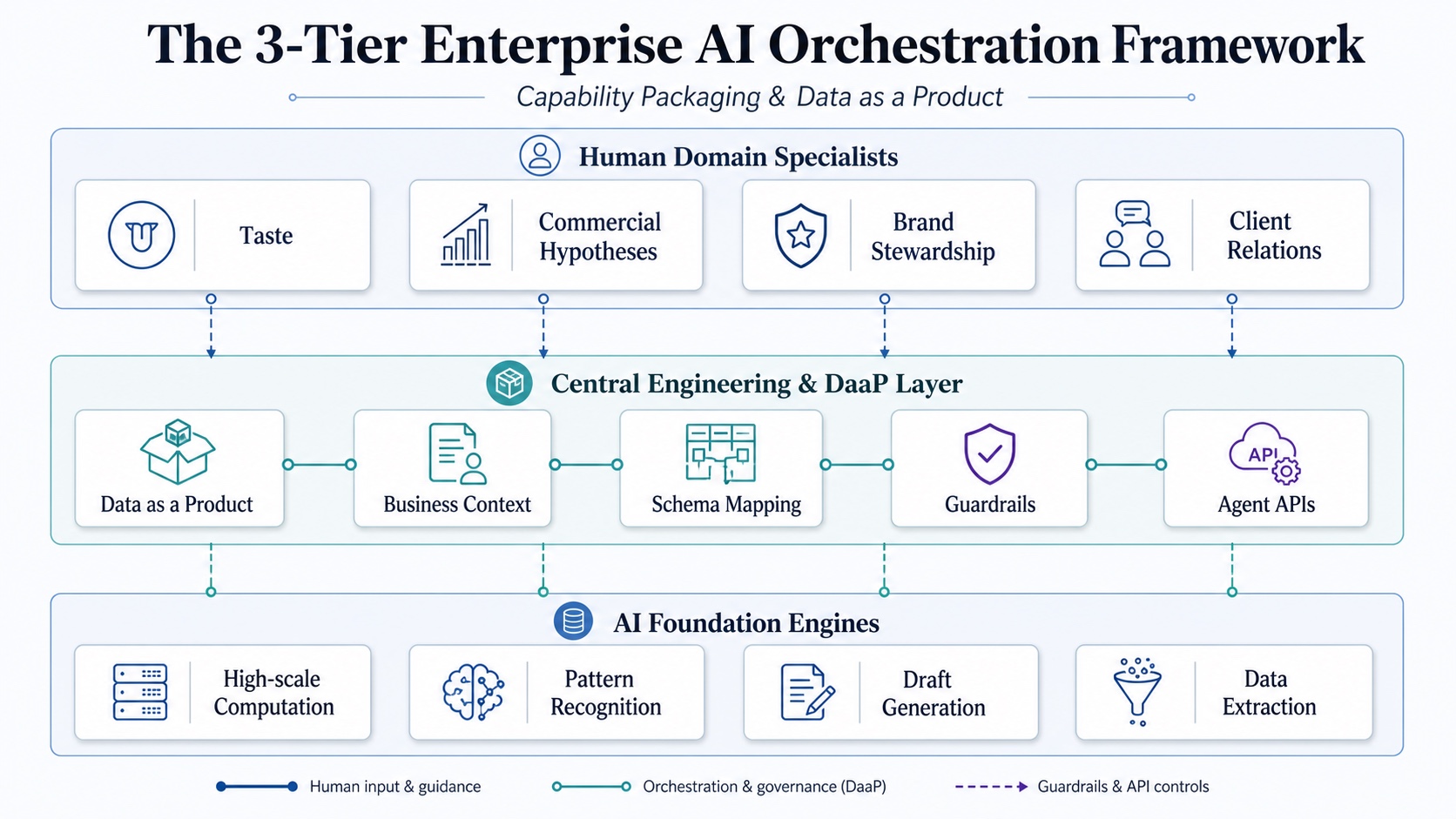
Sustainable AI Transformation (AIX) succeeds by establishing a disciplined division of responsibility among human domain experts, central technical teams, and AI systems:
- Domain experts (Humans): Provide aesthetic taste, brand standards, customer empathy, commercial hypotheses, and final decision-making authority.
- Central technical teams (Humans): Package intuitive interfaces, connect data pipelines, and maintain automated security guardrails.
- AI systems: Execute heavy computation, process unstructured datasets, generate structured initial drafts, and handle routine operational handoffs.
When human taste and domain specialization direct the work, and AI systems handle execution behind the scenes, artificial intelligence shifts from a costly distraction into a durable source of enterprise efficiency.
References
- Business Insider Japan: The Wall Shiseido Faced with 130 AI Ambassadors and Its Next Step (Business Insider Japan, August 5, 2026, by Kazuhiro Matsumoto)